Operators first, developers second.
We've spent 30 years running and scaling technology businesses. We design every agent around how your decisions, approvals, and handoffs actually move, so it does the work the way your best people would.
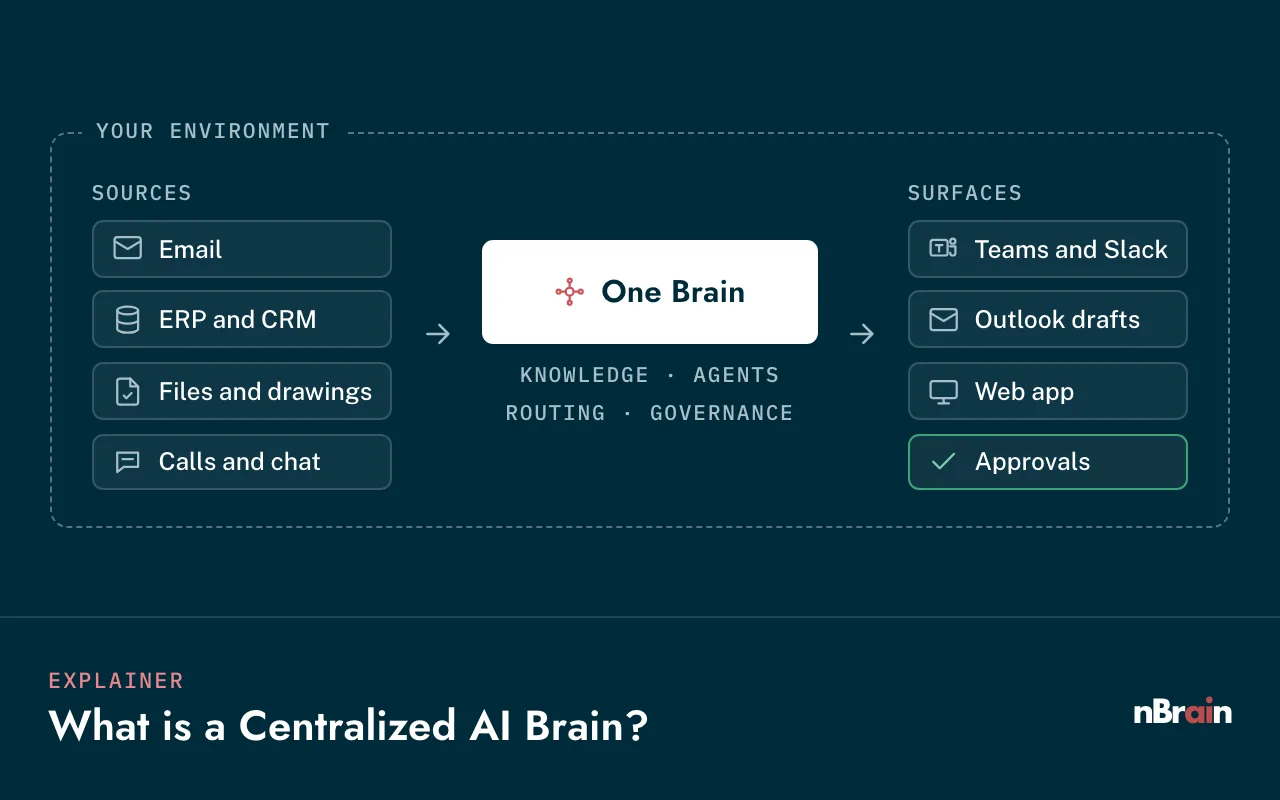
nBrain connects your data, your systems, and the way your people actually work into one AI Brain. Every team and every frontier model behind one login, inside your security boundary, under your rules. Your people get their time back, and the intelligence it builds stays with your company.
Quote Q-2417 · 1,200 brackets
ChatGPT, Copilot, and SaaS AI tools are built for everyone, not around your data, your rules, or your budget. The same four problems show up in almost every company we talk to.
See what changes when it all comes back inside ↓
Or see the full platform →
Your data stays inside your own boundary. A model router replaces per-employee pricing. Permissions, approvals, and an audit trail keep your business in your hands. And the Brain works inside the tools your team already uses, preparing the next step instead of waiting for a prompt.
Inside Slack, Teams, email, and the tools your people use every day. It prepares the next step, like a drafted reply or an updated record, instead of waiting for a prompt.
Role-based permissions are checked on every request. Approval gates sit in front of actions, every step lands in a full audit trail, and you set the guardrails.
Your customers, products, people, projects, and history, plus how each team writes, decides, and approves. Every conversation and outcome adds to what it knows.
One platform that holds your company’s knowledge, memory, and agents. It runs in your environment, under your rules, and gets smarter every day it runs.
GPT-6 Astra, Claude Opus 5.5, Gemini 4 Argon, and open-source models running privately. The router weighs quality, speed, and cost on every request, so hard problems get the strongest model and routine work runs fast and cheap, with no per-seat licensing.
Anything with an API, a webhook, or a database. Your data stays where it lives, permissions carry through from each source system, and nothing trains public models.
The whole Brain runs inside your cloud or on your own servers. Your data stays in the building and never trains public models.
Each task goes to the right model: GPT-6 Astra, Claude Opus 5.5, Gemini 4 Argon, or a private open-source model for routine work. No per-seat licenses, and usage is billed at list price in your accounts.
Access mirrors your roles, a person approves anything that matters, and every action is logged. You set the rules, not a vendor.
The Brain works in Slack, Teams, email, and your CRM, and proposes the next step instead of waiting for a prompt, so people use it without changing how they work.
With nBrain, the platform is built inside your company, not rented from a vendor. Every month of learning stays with you and keeps adding up, so the Brain is worth more each year it runs.
Every decision, answer, approval, and piece of history the Brain learns stays in it and sharpens the next answer.
It sits on your books, not a vendor's. Its value builds the longer it runs. That is hard to put a number on today, but it is yours.
GPT-6 Astra, Claude Opus 5.5, Gemini 4 Argon, and whatever ships next plug into the same Brain. No rebuild, and nothing it has learned is lost.
Rented AI ships each improvement to every customer, your competitors included. What your Brain learns from your work stays with you.
Most AI sits idle until someone types a question. The Brain watches the work: it flags the quote that has sat for three days, preps the brief before the 9 a.m. call, and drafts the follow-up as the meeting ends. Your people approve. It does the legwork.
How work gets done, past answers, customer history, and the reasons behind past decisions live in the Brain, with citations back to the source. A new hire gets the answer a ten-year veteran would give, and every answer follows that person's permissions, so nothing private is exposed.
When someone pastes a contract into a public chatbot, it leaves your control. With nBrain, every request runs inside your environment, under your permissions, with an audit trail, and your data never trains a public model. Your team stops reaching for tools you can't see.
The Brain moves the emails, updates the CRM, chases the status, and writes the first draft, so your estimators estimate, your engineers engineer, and your sellers sell. Our customers average a 33.5% productivity gain within six months.
Most AI sits idle until someone types a prompt. Your Brain keeps working in the background: it notices what needs to happen next, prepares the work, and moves it forward once a person approves.
Your Brain connects to the systems you already run through native connectors, APIs, webhooks, and direct database connections. Anything we don't have a connector for yet gets built as part of your engagement. Access always follows your permissions.
REST and GraphQL APIs, read and write, with the same access your people have.
The Brain reacts the moment something happens: a new order, a ticket, a signed contract.
Direct, read-only by default: SQL Server, Postgres, Snowflake, BigQuery.
SharePoint, Google Drive, shared inboxes, and network file shares.
On-prem ERPs, SFTP drops, and scheduled exports. If it holds data, we can reach it.
Logos are trademarks of their owners and show common systems we connect to.
The first question owners ask us isn't "what can it do?" It's "what happens when it's wrong?" Here is how the controls work day to day, built in from the first week, not added at the end.
Payments, publishing, customer messages, and system changes wait in an approval queue. The Brain surfaces. A human signs.
Access mirrors your company sign-in and each person's role, checked on every request, with changes logged.
Which data, which model, which person, and which action, recorded every time, so you can answer the auditor and the board.
Model calls run through enterprise endpoints that do not train on your data, or through models hosted entirely inside your environment.
Deploy in your AWS, Azure, or Google Cloud tenant, in a U.S. government-grade cloud, or air-gapped on your own servers.
These numbers come from Brains running in production today. Our clients are owner-led companies in defense, healthcare, industrials, energy, and services, and we describe each one by industry. Client names available upon request.
Export controls and the Defense Department's cybersecurity standard put public AI tools off the table, and the know-how behind every quote lived in a few long-tenured people.
One private platform the company owns, in a U.S. government-grade cloud, in use across finance, the floor, and engineering and sales.
Every new device needs a full design-control file: project plan, risk analysis, design inputs, validation protocols and reports, and the 510(k) summary. A small R&D team wrote all of it by hand.
The company owns the platform, the data, and every document, in its own cloud. Every draft is traceable to its sources and approved by a person under the company's document control.
The sales method lived in training decks, not on calls. Inbound leads slipped between the website, marketing, and the CRM. Forecasts were rep estimates, and slowing reorders were noticed late.
All four use cases live on real data at day 78. The handoff was written into the contract, and the company's own developers now run and extend the platform.
Each division ran its own fleet, safety, project, spend, accounting, and payroll systems. Leadership answers took manual exports, unit-price bids were built in spreadsheets, and every field ticket was checked by hand.
An expert estimator accepted the bid calculator and used it on live work. Billing checks are in testing with staff, and memory and actions ship switched off until a person approves them.

A small sales team covered thousands of prospects across several product lines by hand. Client knowledge sat in the CRM, email, file shares, and call recordings, and every signed deal was re-keyed into delivery.
Satisfaction surveys went live company-wide. The company owns the code, runs it in its own cloud, and its own team now develops it, which is how owned AI is meant to work.
A services firm sells its people's time. Every recap, follow-up, proposal, and client update is work that keeps a small team from serving more clients.
Most of the routine work in the firm starts without anyone asking. People decide and approve what reaches a client. We run the company on the platform, so every client build starts from parts we use daily.
Finance, the factory floor, and engineering, inside one of the most security-restricted industries there is. Here is what it took from both sides of the table.
Anyone can open a Claude Code account and build something with a lot of features. For Web 2.0-style software, AI has made building easy. Getting AI to work inside a real company is a different job: people have to adopt it, it has to stay inside its guardrails, and it has to learn from the right feedback.
That takes deep AI knowledge and a real understanding of how a business connects the dots, so an agent can connect them the same way. It's what separates us from an agentic developer. We're business operators with 30 years in tech, and we combine what we know with AI to build products that hold up in a real company.
We've spent 30 years running and scaling technology businesses. We design every agent around how your decisions, approvals, and handoffs actually move, so it does the work the way your best people would.
Every line we build for you is yours: your code, in your cloud, on your model accounts. Nothing connects back to nBrain, and nothing stops working if you stop working with us. It's a true asset on your books.
Most AI vendors sell SaaS, or keep a hook back into their platform. We don't.
For four years we've been building our own agentic build platform, and nBrain runs on it every day. It's how we take a big idea to real, daily use in a few months, with clean, scalable, secure code.
Building is the easy part. Making a Brain streamlined and proactive enough that your staff choose it every day is the hard part. We've spent three years refining our adoption process, and we think it's worth as much as the build itself.
Pick your headcount and see the time handed back to your team, plus what private model routing saves on AI usage.
These are estimates for planning. Real results depend on the workflows in scope, and we take a baseline with you in month one. Builds start at $40,000 and take about 3 months. Model usage runs in your own accounts at list price, with no markup.
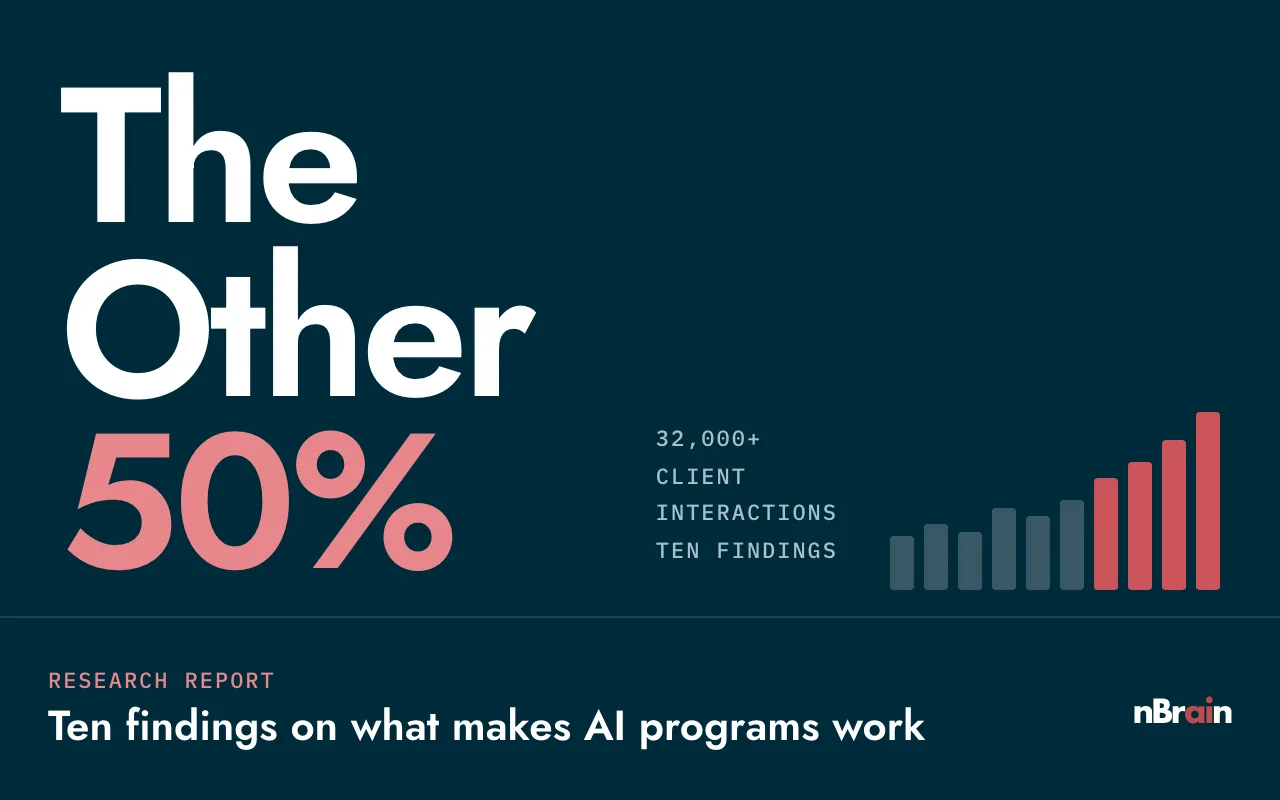
We went back through more than 32,000 of our own client emails, meetings, and messages to find what separates AI programs that work from the ones that stall.

32,000+ interactions and ten findings on the operating model behind every successful build.
Read the report →
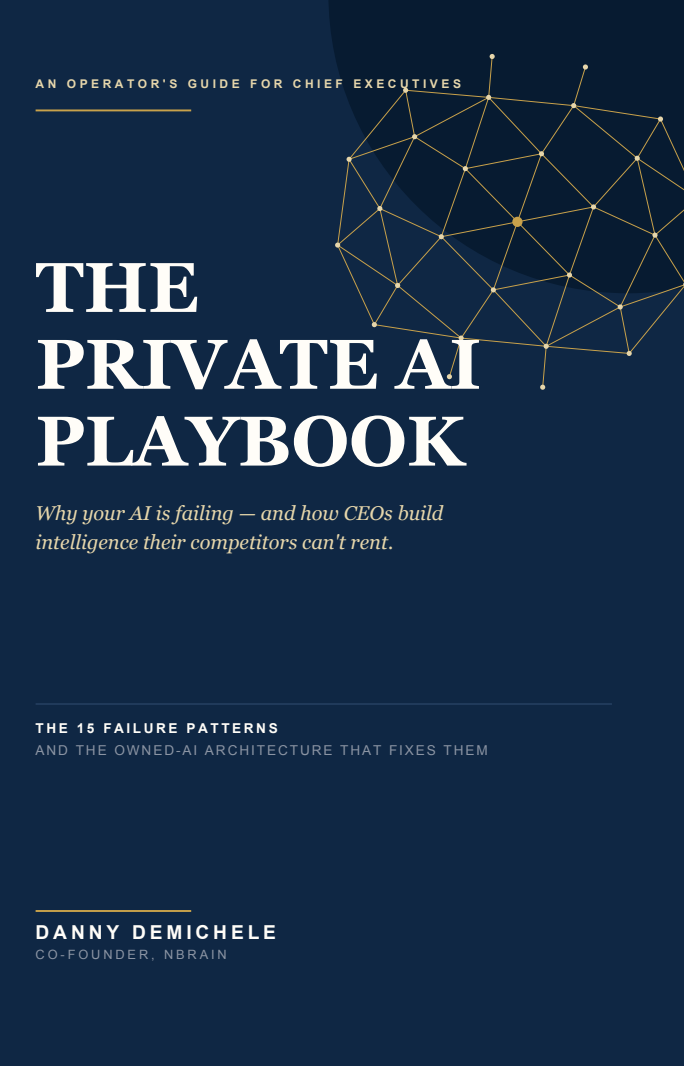
A personalized AI roadmap for your business, printed and shipped to your desk.
Request your book →
The architecture, in plain English, and why it compounds.
Read the explainer →
How to put frontier AI to work when part of your data can't leave the building.
Read the guide →Ownership, security, cost, and how your team actually uses it. Straight answers, no sales call required.
ChatGPT and Copilot are strong assistants, rented per seat, and each one sees its own vendor's apps. Ask them about your business and they are guessing. A Brain uses the same frontier models but grounds every answer in your own data, connects every system you run, including your ERP, CRM, shop floor, and call recordings, takes approved actions, and belongs to you. Many companies keep Copilot for Office documents. The Brain is the layer that knows the whole business.
Enterprise search tools like Glean are good at finding information across many apps, and they suit large enterprises that want one search layer across thousands of seats. They are sold per seat.
nBrain builds a platform around your company's workflows, not a horizontal search layer. You own the code, data, and infrastructure, there is no seat count, and we do the build and the adoption work with you.
You do. The code lives in your repository and the infrastructure runs in your cloud account or on your servers. The data, prompts, agents, workflows, integrations, and the IP we build for you under your engagement are all yours.
Your Brain keeps running. It runs in your account, the code is in your repository, and the model accounts are in your name, so nothing depends on our servers. Your IT team, or another partner, can operate it. We hold every build to that walk-away test.
Your team can build a chatbot. The time goes into the hidden layer: permission-aware search across systems, model routing, evaluation, approval gates, audit logs, cost controls, and keeping all of it current as models change every month. We bring that layer already built and proven in production. Your IT team stays involved, owns the result, and can take it over whenever it wants.
Your data never trains public models. Model calls run through enterprise endpoints that do not train on your data, or through open-weight models hosted inside your environment for anything you don't want leaving your own hardware. You decide which models may see which data, and every call is logged.
In your AWS, Azure, or Google Cloud tenant, a government cloud, your own data center, or a fully air-gapped network with open-weight models running locally. It runs in your account, not ours.
It will sometimes be wrong, so a person decides on every step that matters. The Brain shows its sources, flags low confidence, and routes high-stakes actions such as payments, publishing, and customer messages to an approval queue. Every action is logged, so you can see what happened and why.
Builds start at $40,000. We scope the build with you before anything starts, so you know the price before you commit. Where it lands above that depends on how many systems we connect and how many workflows go live first.
About 3 months for a typical build, from kickoff to a Brain your team uses every day. Your team is testing a first working version on real data well before that.
Your own cloud and model accounts, billed directly to you at list price with no markup. The model router cuts the cost per AI task by about 65%. On top of that, optional ongoing work where we operate and evolve the Brain, scoped and priced to your needs. The Brain keeps running without it.
No. There are no seat licenses. Adding people doesn't add license fees, only the model usage they generate, billed at list price in your own accounts.
We start with work people already find painful, put the Brain inside Slack, Teams, email, and the tools they already use, and train each role on its own work. We stay through adoption, and nothing counts as live until your staff use it unaided.
All the leading ones: GPT-6 Astra, Claude Opus 5.5, Gemini 4 Argon, and open-source models such as Llama, Mistral, and Qwen for private or on-premises work. The Brain routes each task to the model that does it best. Your data, memory, and workflows live outside the model, so you can switch models as better ones ship without losing what the Brain knows.
Have a question that isn't here?The full FAQ answers 70 questions on ownership, security, cost, adoption, and results.
See all FAQsIn one strategy session we map where a Brain would give your people the most time back, and what it would take to get there.
Prefer email? hello@nbrain.ai