RFQ responses without the sales team rebuilding every quote.
For contractors: the Brain reads the RFQ, pulls past quotes, costs, and drawings, and drafts the response for a person to price and approve, inside ITAR and CMMC rules.
nBrain builds one private AI Brain around your contracts, technical data, and quality records. Only the authorized US persons you designate can reach controlled data, nothing is sent to public model vendors, and it runs in your GovCloud or Azure Government tenant, your own data center, or a network with no internet connection at all.
The same platform is already running real work for nBrain clients, including a Tier 2 defense manufacturer.
Regal Technology Partners has shared its story publicly. Other results are anonymized to protect client confidentiality. Read the customer stories
Written for the CEO, compliance officer, or ISSO who has to sign off. nBrain supports your compliance program. It doesn't replace it, and it doesn't ask you to widen the boundary you've already built.
Match the deployment to the data. Most contractors run in a government cloud tenant. Programs with the most sensitive technical data run on-prem or fully disconnected. The Brain, its controls, and its audit trail are the same in all three.
The Brain runs in a US-only cloud region you already operate, under your accounts, your keys, and your authorization.
Installed on servers and GPUs you own, behind your firewall, and managed under the controls you already run on-site.
A network with no route to the internet. Nothing calls home, nothing phones a vendor, and nothing leaves.
GPT-6 Astra, Claude Opus 5.5, and Gemini 4 Argon are hosted services, so they can't run on a network with no internet. An air-gapped Brain uses open-weight models on your own hardware instead. Those models handle search, cited answers, summaries, extraction, and first drafts well. On the hardest multi-step reasoning they can trail the frontier models, so before go-live we test them on your own documents and show you where the difference matters. Hardware is sized to your users and the models you choose.
Roles come from your identity provider, including the US-person attribute your security team maintains. Controlled data is never served to a user without it.
Can be built to read banner and portion markings and export-control legends, carry them onto outputs, and flag unmarked content that looks controlled for a person to review.
Anything that leaves the boundary, goes to a customer or supplier, or changes a record waits for a named person to approve it.
Every prompt, source, model, user, and action, written to logs in your environment and your SIEM, ready for your ISSO or assessor.
How defense manufacturers and contractors can use AI inside CUI, ITAR, and CMMC requirements: where it runs, who can see what, what changes when it's air-gapped, and which workflows to start with.
Each team starts with one costly, everyday job. The Brain does the searching, matching, and first drafts on controlled data, inside your boundary. Your people make the calls.
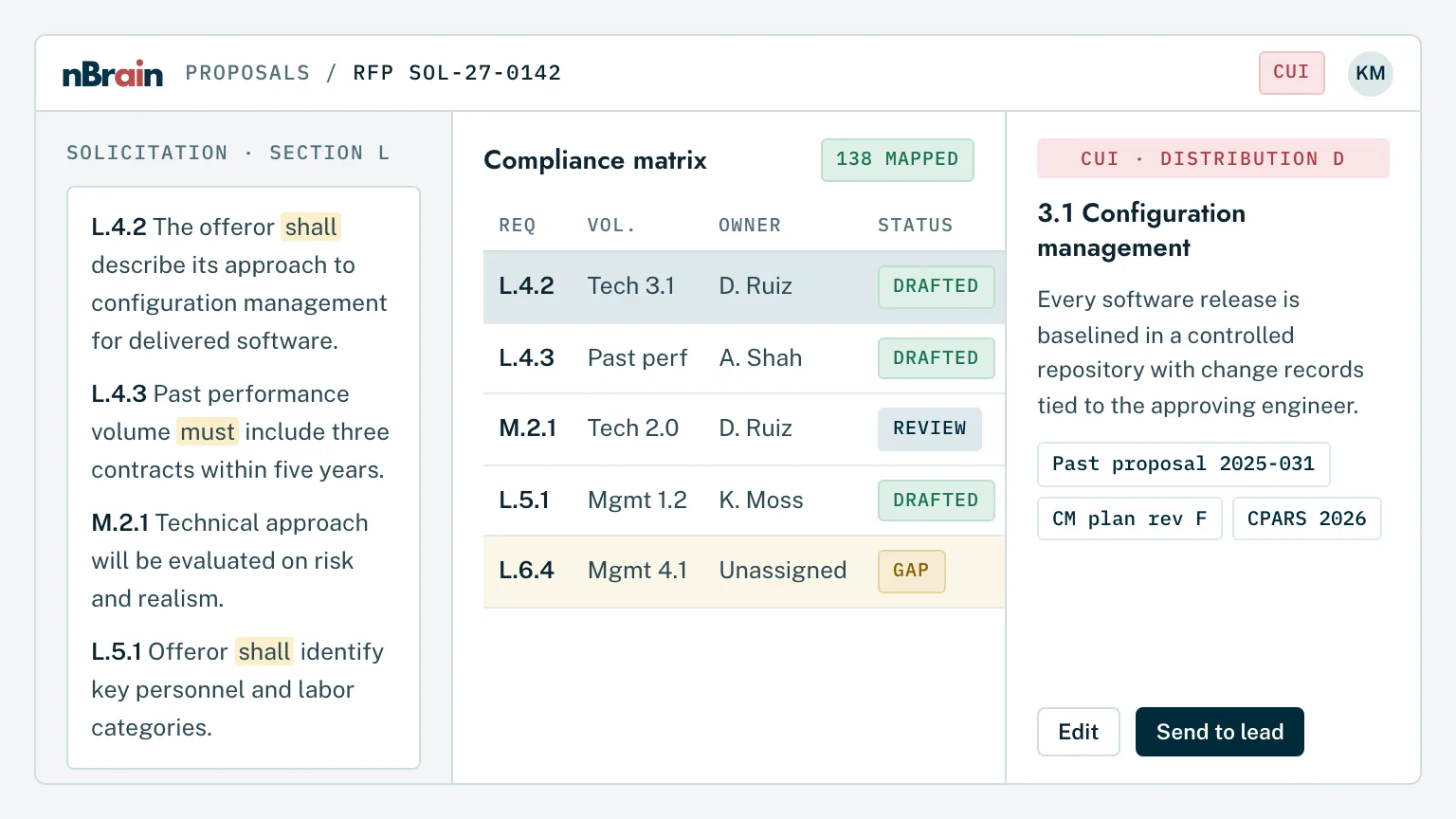
The Brain reads the solicitation, builds the compliance matrix, and drafts the response from your past performance, resumes, and approved boilerplate. Source material marked CUI or export-controlled stays inside your boundary and is only used for people cleared to see it.
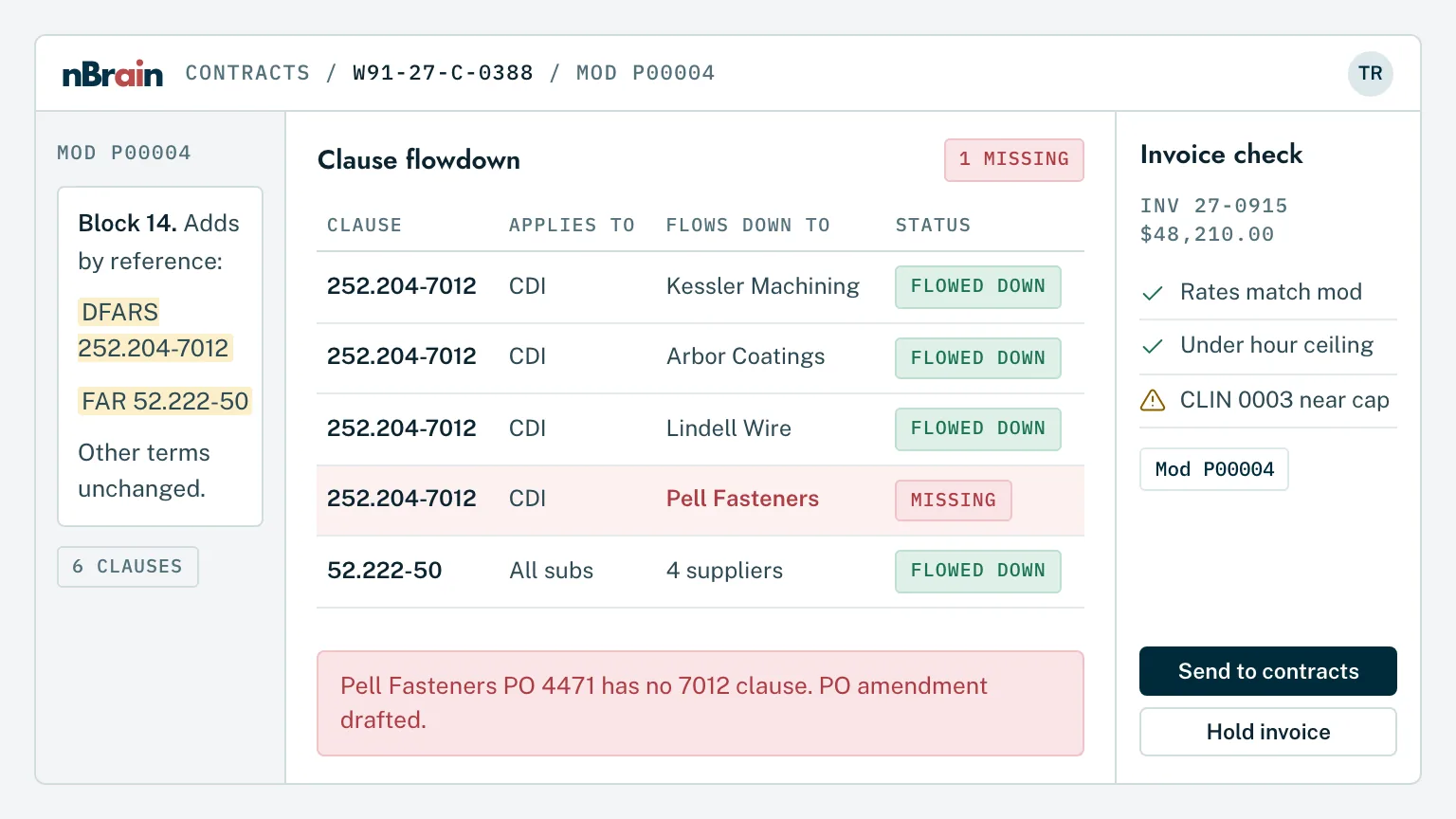
The Brain reads your prime contracts, modifications, and purchase orders, tracks the FAR and DFARS clauses in each, and checks that the right ones flow down to every subcontractor, including 252.204-7012 and the export-control clauses.
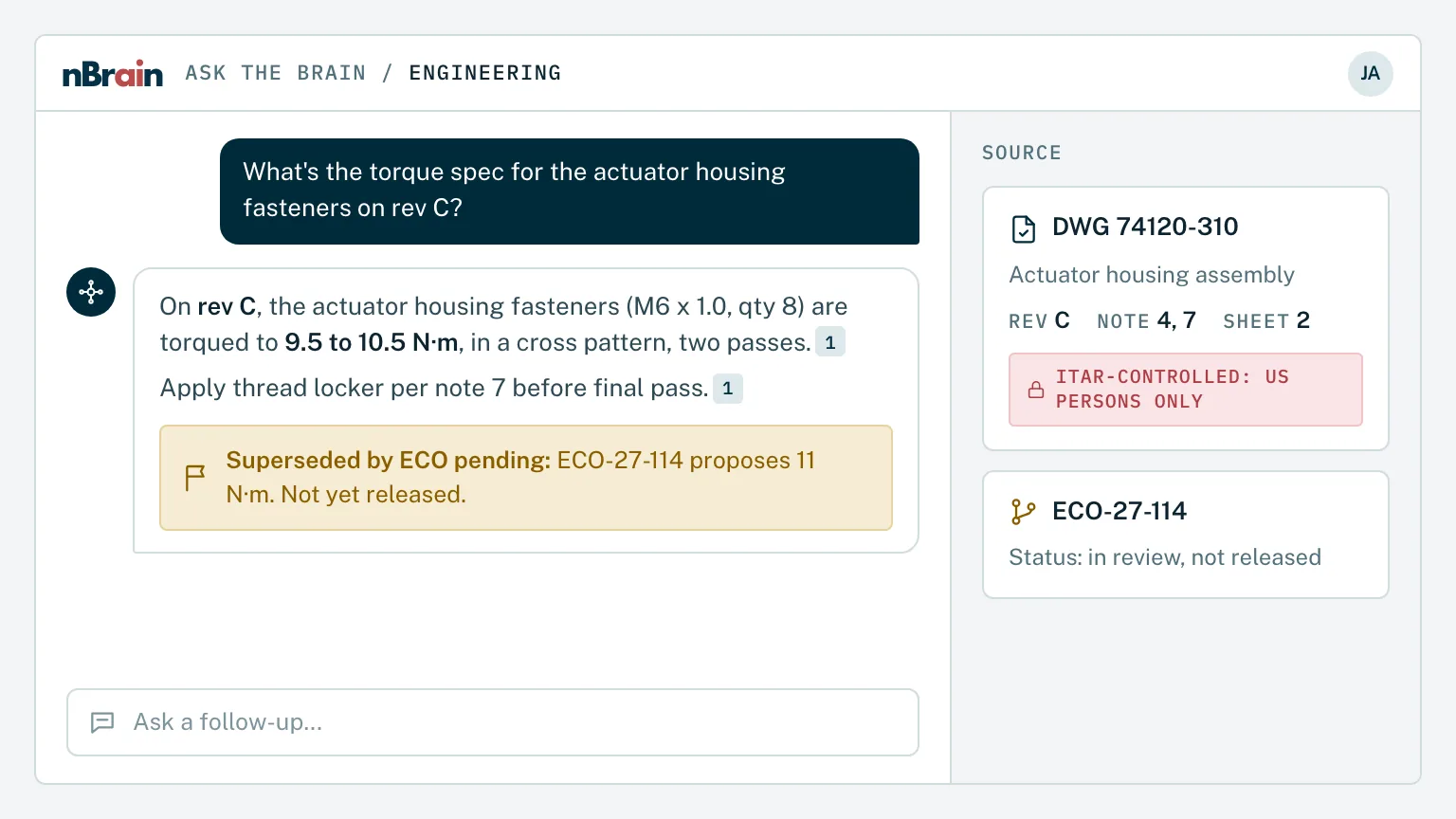
Engineers ask in plain English and get answers drawn from drawings, specifications, work instructions, test reports, and engineering change history, with a link to the exact document and revision. Technical data under ITAR or the EAR is only searched and shown for users your system marks as authorized US persons.
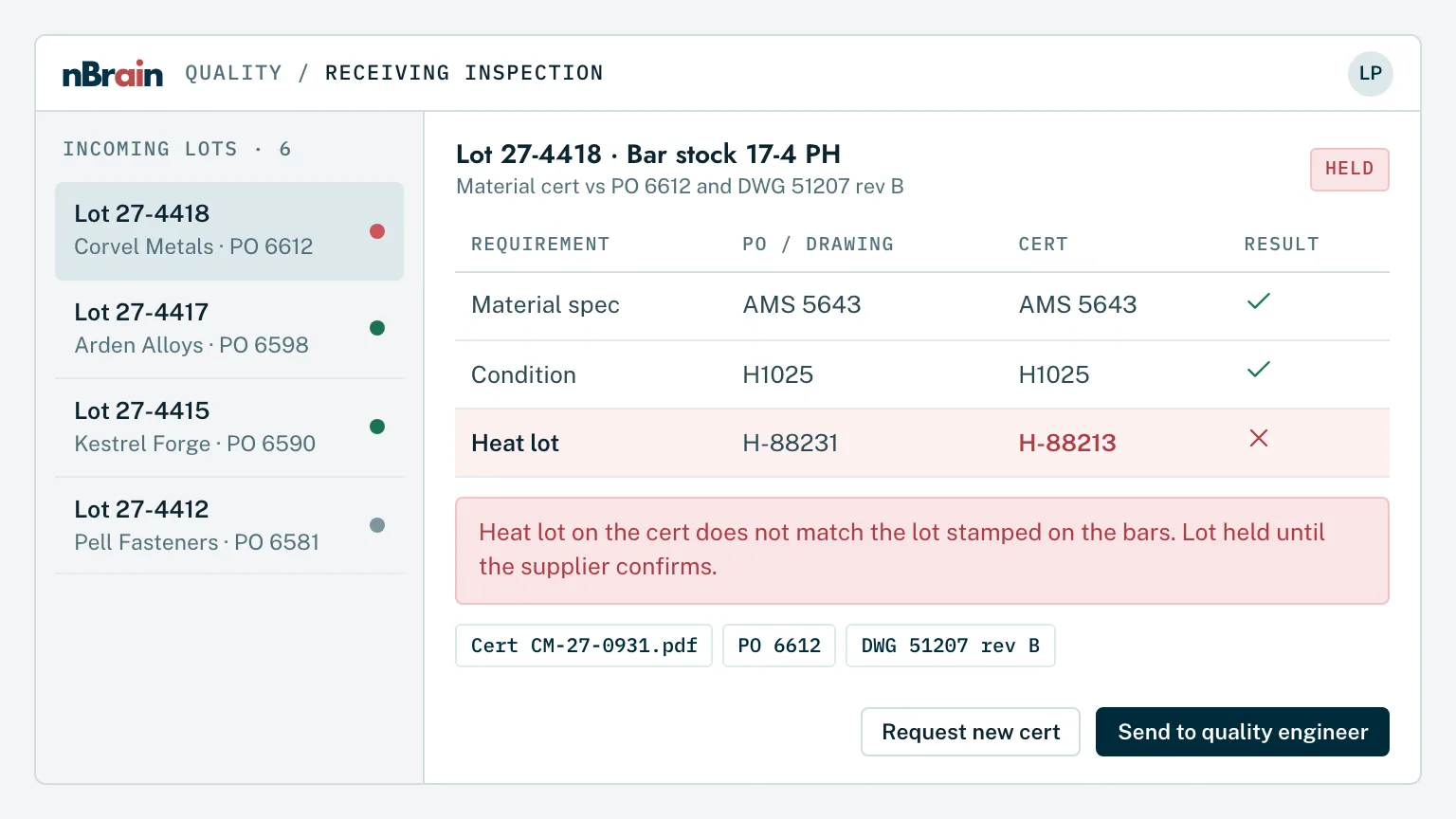
The Brain reads certificates of conformance, material certs, first article inspection reports, and supplier corrective actions, compares them against the PO, drawing, and spec, and flags what's missing or out of tolerance for your quality engineer to disposition.
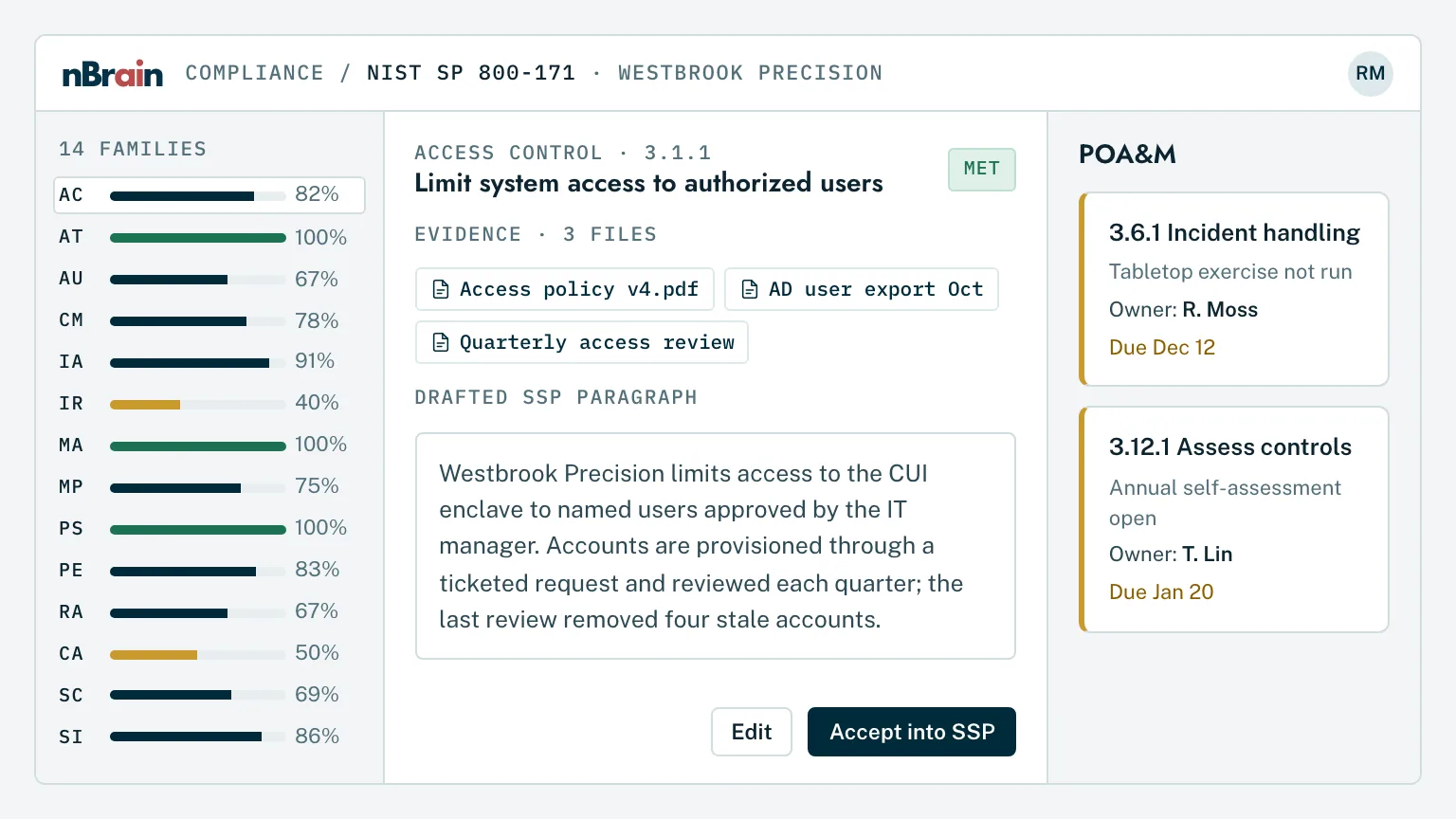
Assessment prep is mostly collecting evidence and keeping documents current. The Brain maps your policies, configurations, and logs to the 110 NIST SP 800-171 requirements, drafts SSP updates when something changes, and tracks every POA&M item to closure, for your ISSO to review and sign.
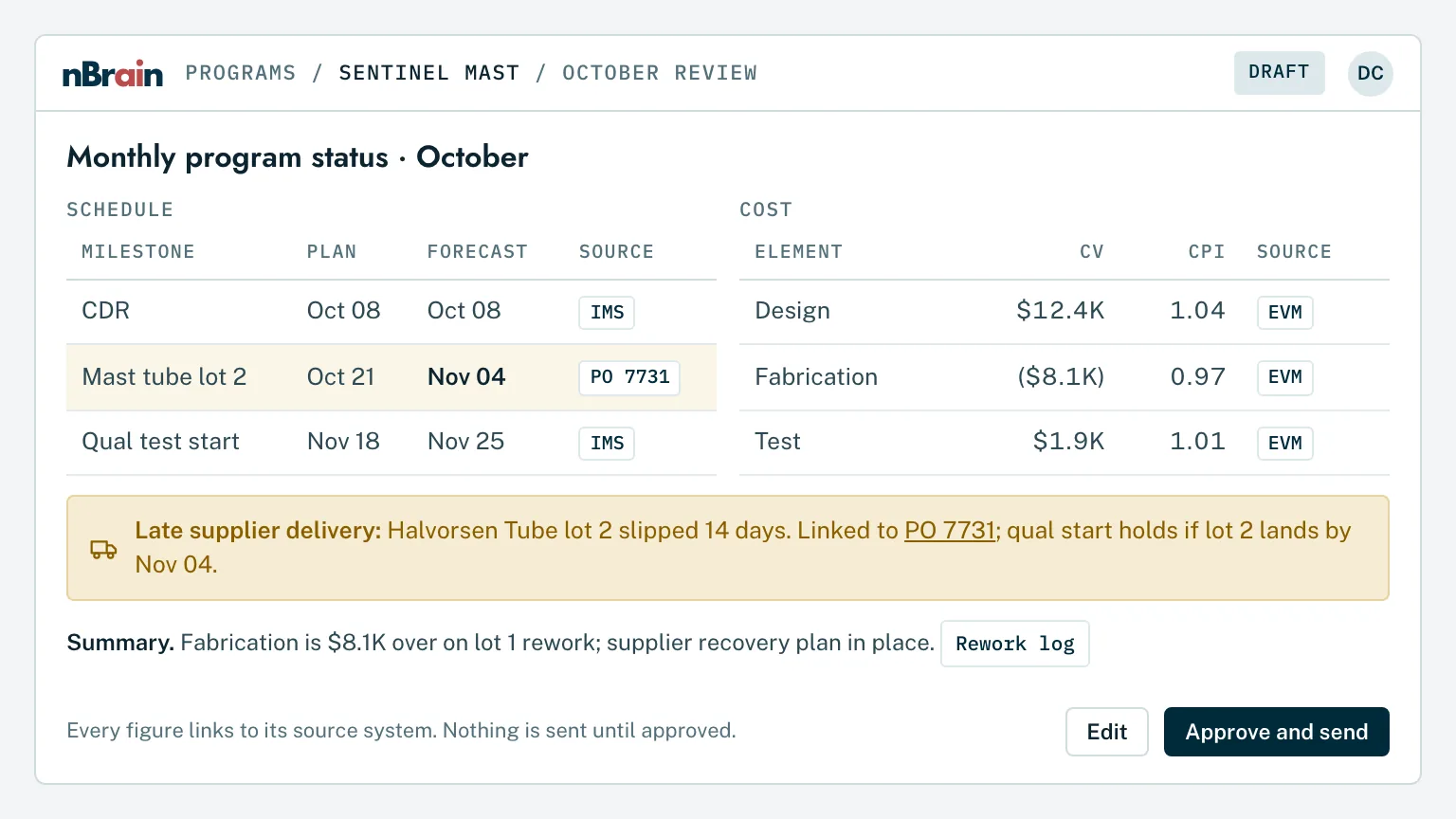
The Brain pulls schedule, cost, quality, and supplier data from your ERP, MES, and project systems and drafts monthly program reports, customer status updates, and review decks for the program manager to finish.
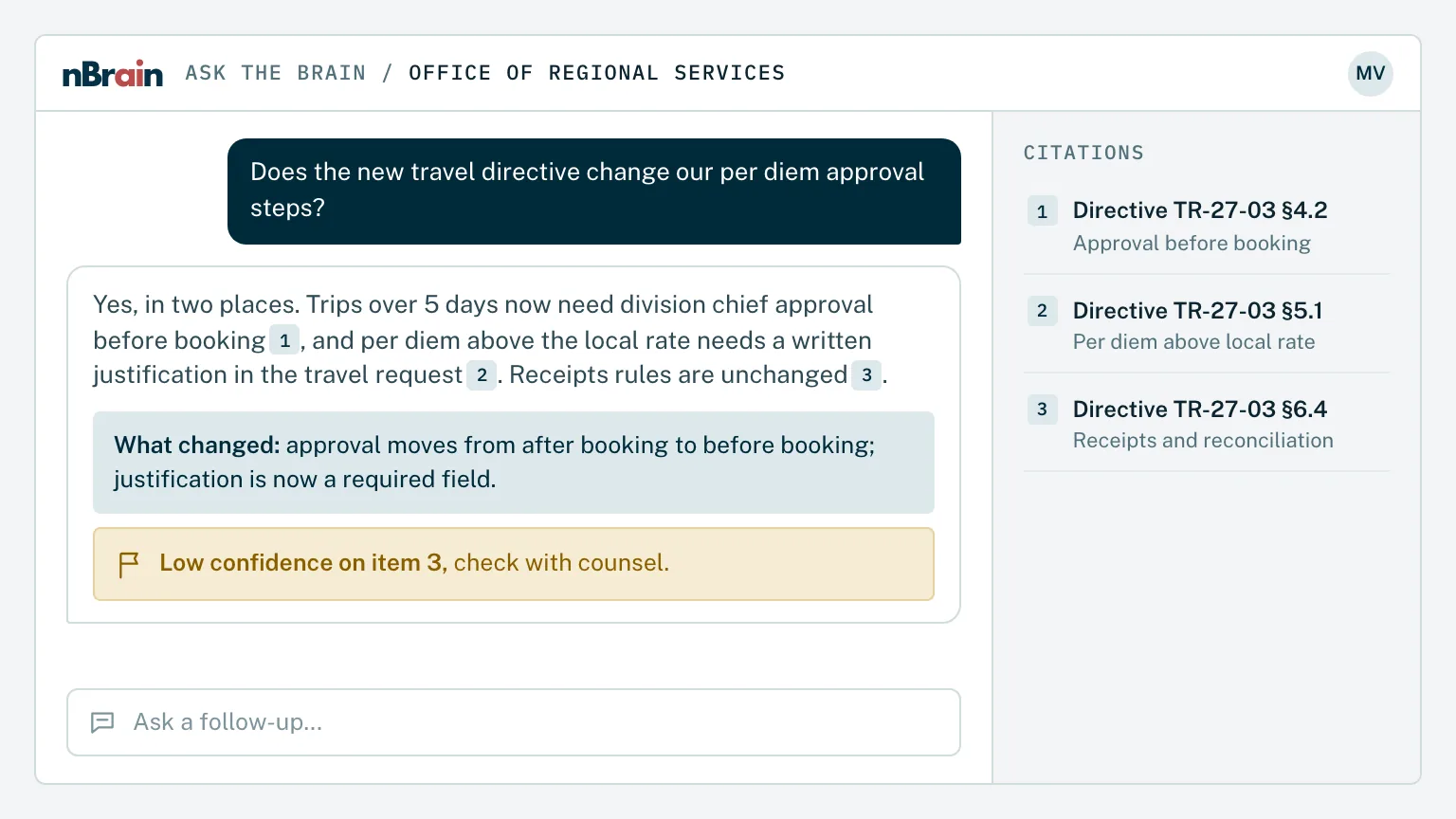
Staff ask in plain English and get an answer drawn from your statutes, regulations, directives, guidance memos, and prior determinations, with a link to the exact section it came from.
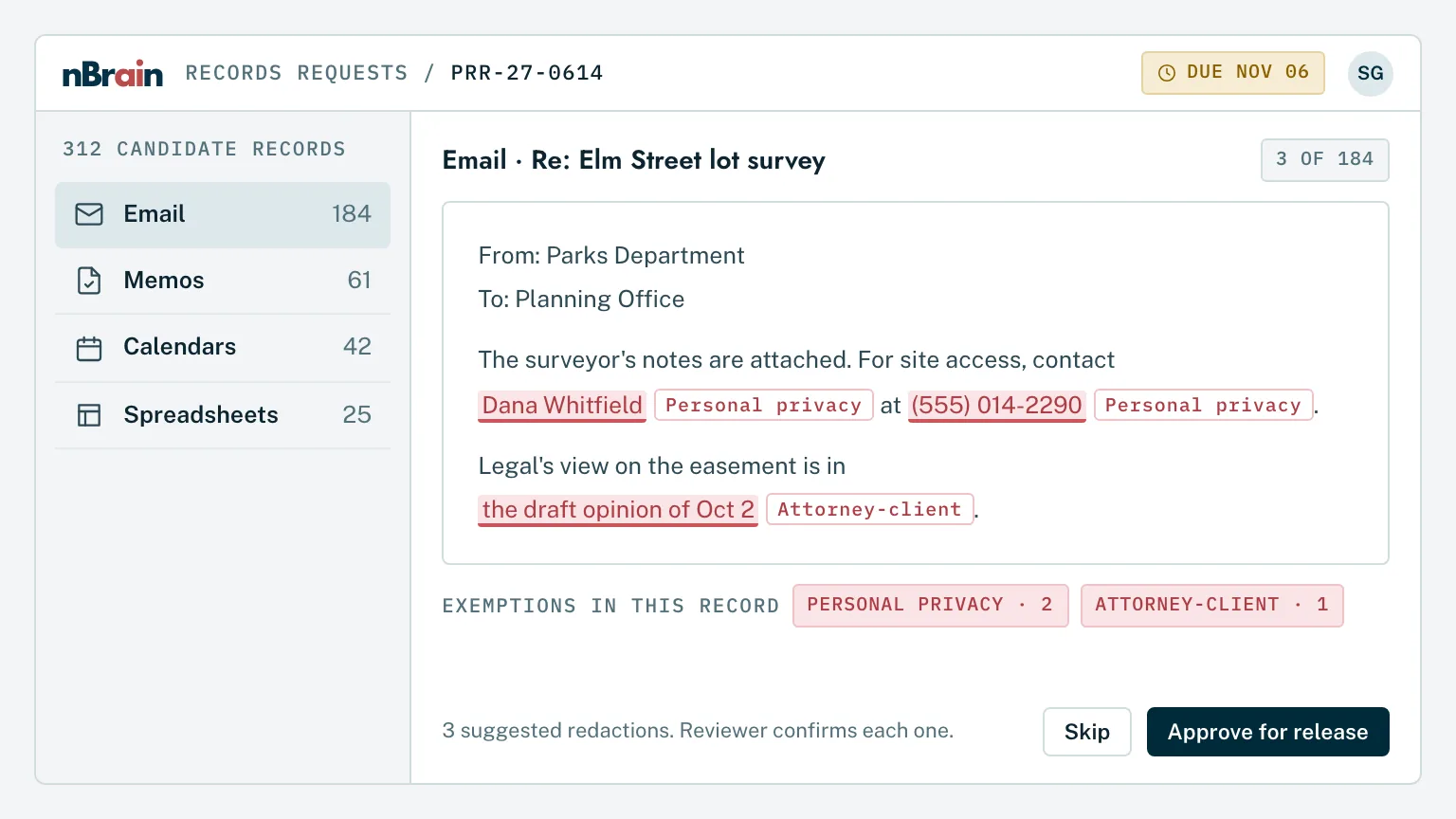
For FOIA and state public-records requests, the Brain searches email, shared drives, and case systems at once, groups what it finds, and suggests redactions for your records officer to review. Nothing is released without a person signing off.
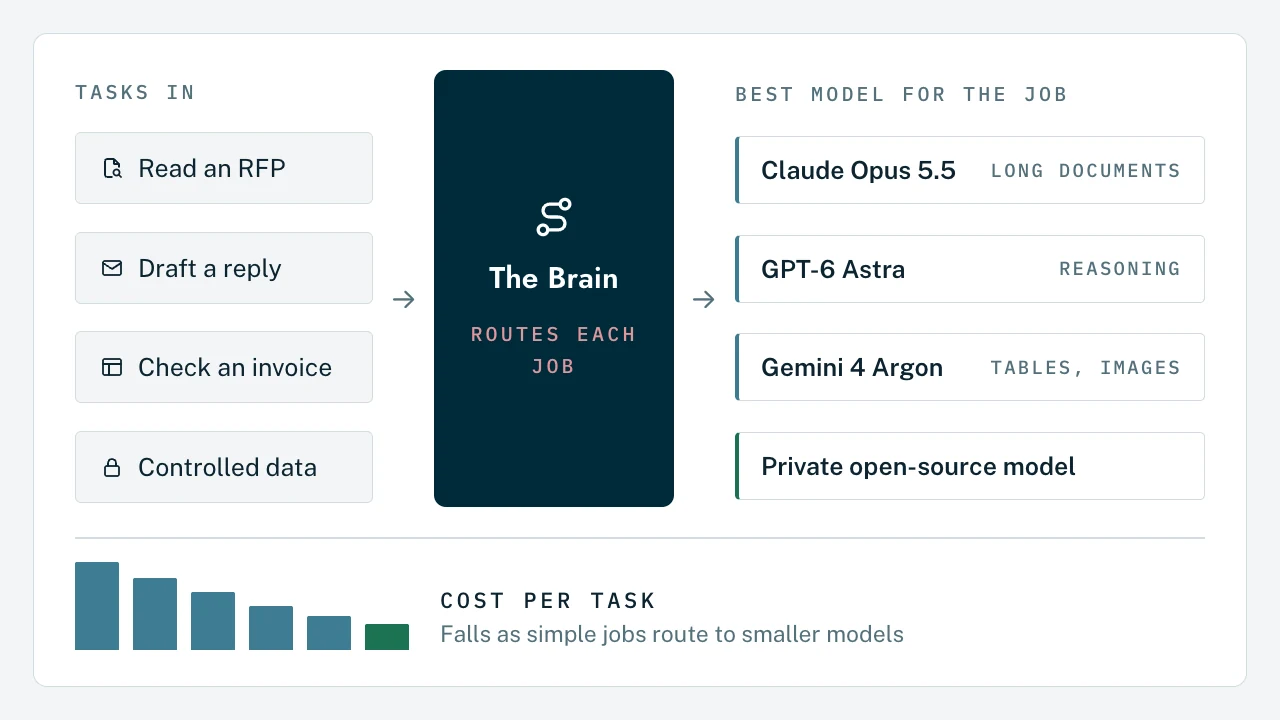
Your systems feed one knowledge layer. The Brain routes each task to the right model and takes action in the tools your staff already use, under the rules you set.
Stood up in your AWS GovCloud or Azure Government tenant, on your own servers, or on a network with no internet.
Your document stores, engineering systems, email, and databases, read-only by default.
Agents search, draft, check, and route. A person approves anything that leaves the building.
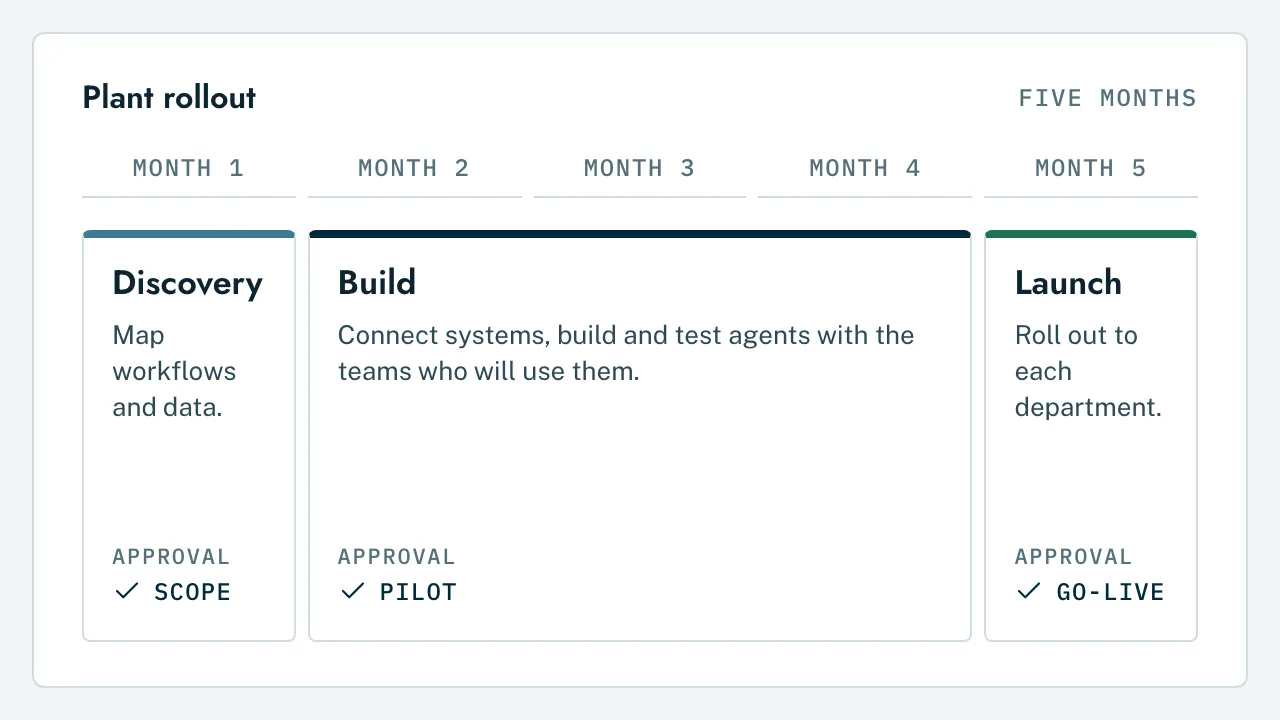
We take a baseline in month one, then add the next workflow on the same data and permissions.
The first question a defense CEO or ISSO asks isn't "what can it do?" It's "where does the data go, who can see it, and what happens when it's wrong?" These controls are built in from the first week.
Deployed in your GovCloud or Azure Government tenant, on-prem, or air-gapped, so CUI and ITAR data stay inside the boundary you already maintain.
Role-based access mirrored from your identity provider and source systems, including US-person status, checked on every request.
Anything sent to a customer, supplier, or the public, any payment, and any record change waits in a queue until the right person approves.
Which data, which model, which person, and which action, recorded every time, ready for your ISSO, C3PAO, or inspector general.
Prompts, outputs, and logs follow your retention schedules and legal holds, and stay searchable for records requests.
What we do and don't claim. nBrain does not hold a FedRAMP authorization, a CMMC certification, or a DoD Impact Level authorization of its own, and ITAR has no certification to hold. The Brain deploys inside an environment you have already authorized, so it sits within your existing controls and assessment boundary like any other system you run. We document the architecture and controls to support your ATO, CMMC assessment, and export compliance program.
Each agent has one job, a defined set of tools, and guardrails on what it can do. They share the same data, US-person permissions, and audit trail, so each new one ships faster than the last.
Pulls every requirement and maps it to a response section.
Tracks which FAR and DFARS clauses apply and where they flow down.
Cited answers from drawings and specs, for authorized US persons only.
Flags documents that may be ITAR or EAR controlled for your empowered official to review.
Matches supplier certs and first articles against the PO and drawing.
Maps evidence to 800-171 requirements and drafts SSP updates for your ISSO.
Drafts monthly program reviews from schedule, cost, and quality data.
Checks invoices against contracts and holds anything suspicious.
Every agent is built for your environment and your rules, not pulled from a shared library. What is a Centralized AI Brain? →
These results come from Brains running for nBrain clients today, starting with a Tier 2 defense manufacturer working inside ITAR and CMMC rules.
For contractors: the Brain reads the RFQ, pulls past quotes, costs, and drawings, and drafts the response for a person to price and approve, inside ITAR and CMMC rules.
For contractors: one platform launched across operations, finance, and sales, with each team using the same knowledge and the same approval rules.
For contractors and agencies: each task goes to the model that fits it, including private models inside your boundary, so routine work stops paying frontier-model prices.
Regal Technology Partners has shared its story publicly. Other results are anonymized and no result is attributed to a government agency.
There is no ITAR certification for any product to hold. ITAR is a regulation your company complies with, and the Brain is built to support that compliance. It runs only on US infrastructure you control, it shows ITAR-controlled technical data only to users your system marks as authorized US persons, nBrain staff reach it only through accounts you issue, and no technical data is sent to public model vendors. Your empowered official keeps the final say on what is controlled and who may see it.
Yes. In a fully air-gapped deployment the Brain runs on your own servers and GPUs on a network with no route to the internet. Models are open-weight models such as Llama, Mistral, or Qwen running locally. How updates reach the network is scoped per program, and your team approves each one before install.
The honest trade-off: GPT-6 Astra, Claude Opus 5.5, and Gemini 4 Argon are hosted services and can't run disconnected. Open-weight models handle search, cited answers, summaries, and drafting well, and can trail on the hardest reasoning, so we test on your documents before go-live and show you where it matters.
Not to their public services, and never to train their models. Controlled data stays inside your boundary. Where your government cloud offers approved frontier-model endpoints, such as models hosted in your Azure Government or AWS GovCloud tenant, the Brain can use them for the work you allow. For anything you don't want leaving your own hardware, it uses open-weight models running in your environment. You decide which models may see which data, and every call is logged.
The Brain deploys inside your existing environment. You add it to your SSP and system inventory like any new application, and we give you the architecture, data-flow diagrams, and control mapping to NIST SP 800-171 your assessor will ask for. How it affects your assessment is for your assessor and counsel to confirm. nBrain isn't CMMC certified itself.
Only the nBrain staff you approve can reach your environment, only through accounts you issue inside your boundary, and only for the scope and time you grant. You can revoke that access at any time, and every session is recorded in your audit trail. In an air-gapped deployment, access happens on site or through whatever controlled path you approve. The Brain's data stays in your environment.
No, and we don't need to be for most deployments. nBrain doesn't run your Brain on our servers. We deploy it inside an environment you have already authorized, such as your AWS GovCloud or Azure Government tenant, an IL4 or IL5 environment your program already has, or your own data center. It falls within your existing controls and assessment boundary, and we document the architecture and controls to support your ATO or CMMC assessment.
It is designed to, when it runs inside an environment authorized for CUI. Data stays in your tenant, access follows your roles, CUI markings can be carried onto outputs, model calls go to endpoints inside your boundary or to models hosted in your environment, and every request is logged. Your data never trains public models.
Access mirrors your identity provider and the permissions in each source system, including the US-person attribute your security team maintains. Every request is checked against the user's role, so people only see what they're already allowed to see. Permission changes are logged.
It will sometimes be wrong, so it's built for that. Answers show their sources, low-confidence answers are flagged, and anything that leaves the building, such as a proposal section, a supplier notice, a payment, or a records release, waits for a person to approve it. Every step is logged, so you can see what happened and why.
Microsoft 365 and GCC High, SharePoint, file shares, email, ERP, MES, PLM, and quality systems, and databases, through native connectors, APIs, and direct read-only connections. Older systems can be reached through scheduled exports or SFTP. Anything without a connector is built as part of the engagement.
With one high-volume workflow where people spend time searching and drafting, such as RFP compliance matrices, clause and flowdown checks, supplier cert review, or CMMC evidence upkeep. Agencies often start with policy questions or records requests. We take a baseline in month one and measure hours returned, then add the next workflow on the same foundation.
Prompts, outputs, and logs are stored in your environment and follow the retention schedules and legal holds you set. For agencies, they are searchable like any other record, so they can be produced in response to a FOIA or state public-records request.
Your team can build a chatbot. Most of the time goes into what sits around it: permission-aware search, model routing, evaluation, approval gates, audit logs, and keeping all of it current as models change. We bring that layer already built. Your IT team stays involved, owns the code and data, and can take it over at any time.

How to put frontier AI to work when part of your data can't leave the building.
Read the guide →
Putting AI to work inside CUI, ITAR, and CMMC requirements.
Read the guide →
Finance, the factory floor, and engineering on one Brain, inside a security-restricted industry.
Read the story →
32,000+ client interactions and the operating model behind every successful build.
Read the report →In one strategy session we map where a Brain would give your team the most time back, which deployment fits your data, from GovCloud to fully air-gapped, and what your empowered official, ISSO, and assessor will want to see.
Prefer email? hello@nbrain.ai