Clinics and specialty practices · Behavioral health · Health systems · Research · Health tech
Private AI for healthcare, built around HIPAA. It runs inside your own cloud or data center, and PHI is never used to train public models.
nBrain builds one private AI Brain around your policies, schedules, payer rules, and operating data. Each person sees only the minimum necessary for their role. Every access is logged. Your staff approve anything that reaches a patient, a payer, or a chart. It runs in your HIPAA-eligible Azure or AWS account, or on servers you own.
Deploys in your HIPAA-eligible cloud or on-premMinimum-necessary access, checked on every requestPHI never trains public models
The same platform is already running real work for nBrain clients in regulated industries.
92%
less sales-team time on RFQs at Regal Technology Partners, a Tier 2 defense manufacturer
5 months
from first idea to a Brain built and launched across a 200-person manufacturer
65%
lower cost per AI task, because the orchestrator sends each task to the right model
33.5%
average increase in employee productivity within six months
These results come from nBrain clients across industries. None of them is a healthcare client, and none involves PHI.
HIPAA, rule by rule
What each rule requires, and how the Brain is built to meet it.
This section is for the compliance officer, privacy officer, or CISO who has to sign off. nBrain supports your HIPAA program. It doesn't replace it, and your policies stay the rules the Brain follows.
Rule
What it requires
How nBrain handles it
HIPAA Privacy Rule45 CFR 164, Subpart E
PHI may be used and disclosed only for permitted purposes, and most uses must be limited to the minimum necessary for the job. Patients have rights to access and to an accounting of certain disclosures.
Access follows roles from your identity provider and source systems, so a scheduler doesn't see clinical notes and a biller doesn't see therapy notes.
Each agent is scoped to the fields its job needs. That is minimum necessary, enforced by the system rather than by a policy memo.
Workflows that need no PHI, such as policy Q&A, payer rules, and staff training, are built on non-PHI data from the start.
HIPAA Security Rule45 CFR 164, Subpart C
Administrative, physical, and technical safeguards for electronic PHI: risk analysis, access control, audit controls, integrity, authentication, and transmission security.
Runs in your HIPAA-eligible cloud account or on your own servers, so it inherits the safeguards you already run.
Encryption in transit and at rest, including the vector index. Search indexes built from PHI are PHI too, and we treat them that way.
Every prompt, source, model, user, and action is written to a tamper-evident audit log in your environment, ready for your security risk analysis.
Business associate agreements45 CFR 164.502(e), 164.504(e)
Any vendor that creates, receives, maintains, or transmits PHI for you is a business associate and needs a BAA before it touches PHI. That includes cloud and model providers.
Your cloud provider's BAA covers the infrastructure, because the Brain runs in your account.
Models that see PHI are reached only through BAA-covered endpoints you approve, such as Azure OpenAI, Amazon Bedrock, or Google Vertex AI, with no training on your data.
We sign a BAA where PHI is involved, before any PHI moves.
Breach Notification Rule and HITECH45 CFR 164, Subpart D
Breaches of unsecured PHI must be reported to affected patients and HHS without unreasonable delay, and no later than 60 days after discovery. Business associates must tell you first.
Logs stream to your SIEM, so the Brain is part of your incident detection, not a blind spot.
The audit trail shows exactly which records a user or agent touched, which narrows an investigation from “everything” to a list.
Encryption at rest is designed to keep a lost disk or snapshot from being a breach of unsecured PHI.
42 CFR Part 2Substance use disorder records
Records from federally assisted SUD programs carry consent and redisclosure rules beyond HIPAA. The 2024 update aligns Part 2 more closely with HIPAA, but those records still need their own handling.
Part 2 records can be tagged at ingest and kept in a separate, consent-aware store, so they are only used where the patient's consent allows.
Redisclosure notices can be carried onto any output that draws on Part 2 records.
State health privacy lawsFor example, California CMIA · Texas HB 300 · Washington MHMDA
Many states add rules on top of HIPAA, such as stricter consent, staff training, or consumer health data protections that reach beyond covered entities.
Access rules, retention, and consent flags are configured per state and per location.
Data can be held in the US region you choose, and it never leaves your account.
What we do and don't claim. There is no such thing as a HIPAA certification, for nBrain or for any AI product. HIPAA is a set of rules that you and your business associates comply with. nBrain does not hold a SOC 2 report or HITRUST certification. The Brain is built for HIPAA-regulated environments and deploys inside an account or data center you already secure. We document the architecture, data flows, and safeguards your privacy officer, security team, and auditors will ask for.
Health tech and device makers. The same platform drafts FDA and ISO 13485 regulatory documents for a medical device reprocessing company, inside that company's own Azure account. Read the story →
Data classification and risk
What the Brain can see, what could go wrong, and how it's handled.
Every record is labeled when it comes in. The label decides who can see it, which model can read it, and where it can go. Here is the plain-language version of the risk assessment we write with you before a build starts.
Class 01
PHI
Health information tied to a person, covering any of the 18 HIPAA identifiers. Examples: names with visit dates, medical record numbers, diagnoses, treatment plans, insurance IDs, call recordings with patients.
How the Brain treats it: stays in your account, is shown only to roles that need it, goes only to BAA-covered or local models, and every access is logged.
Class 02
PII that isn't PHI
Personal data about staff, referral partners, and vendors. Examples: employee records, contact details, credentialing files, payroll.
How the Brain treats it: role-based access, encrypted, and kept out of general search unless the role needs it.
Class 03
Internal
Your operating knowledge. Examples: policies, SOPs, payer rules, fee schedules, training material, contracts.
How the Brain treats it: available to staff by role. This is where most first workflows start, because it needs no PHI.
Class 04
Public
Information anyone can see. Examples: your website, published guidelines, FDA databases, payer policy pages.
How the Brain treats it: can be used with any approved model, and is cited like any other source.
The risk assessment, in plain language
Risk
Where it shows up
How it's mitigated
PHI sent to a public modelData leakage
A staff member pastes a patient note into a consumer chatbot, or an AI feature in a SaaS tool sends PHI to a vendor without a BAA.
The Brain gives staff a sanctioned tool to use instead. PHI goes only to BAA-covered or local models, and identifiers can be stripped or tokenized before a model sees the text, wherever the task allows.
Over-broad accessMinimum necessary
Search tools that index everything let anyone with a login find anything, including records they should never open.
Permissions mirror your identity provider and source systems, and they are checked on every request, not just when a folder is opened. Access changes are logged.
Unsecured APIs and integrationsBreach vector
Connections to the EHR, phone system, or clearinghouse use shared keys or open endpoints.
Read-only by default, service accounts scoped per system, keys stored in your key vault, and traffic kept inside your network where the vendor allows.
Unencrypted storageBreach vector
Exports, caches, and vector indexes hold copies of PHI that nobody counts as PHI.
Every store is encrypted at rest with keys you control. Indexes built from PHI are classified as PHI and get the same retention and deletion rules.
Third-party and vendor accessIncluding nBrain
Outside engineers keep standing access to production data long after they need it.
nBrain staff work through accounts you issue, for the scope and time you grant. Every session is logged, and you can revoke access at any time.
Wrong or biased outputModel risk
A model gives a confident wrong answer, or performs worse for some patient groups.
Answers cite their sources and say when support is missing. Nothing clinical is decided by the Brain. We test on your own records before go-live and review results by group where it matters.
Patient consent and transparencyTrust
Patients don't know AI is involved in a call, a message, or a recording.
Your consent language and disclosures are built into the workflow, for example notice before a call is recorded or transcribed, and a person signs off on anything sent to a patient.
Where it runs
Option 01 · Your cloud
Your HIPAA-eligible Azure or AWS account
The Brain runs in an account you already operate under your cloud provider's BAA, with your keys and your network rules.
Models
GPT-6 Astra, Claude Opus 5.5, or Gemini 4 Argon through BAA-covered endpoints in your account, plus open-weight models you host.
PHI
Stays in your account. Only HIPAA-eligible services are used for anything that touches it.
Option 02 · On-premises
Your data center, your hardware
Installed on servers and GPUs you own, behind your firewall, under the physical and technical safeguards you already run.
Models
Open-weight models such as Llama, Mistral, or Qwen on your GPUs. Hosted models only if you approve a BAA-covered connection.
PHI
Never leaves your building unless you allow it.
Option 03 · Isolated
Disconnected, for the most sensitive data
A network with no route to the internet, for research datasets or records your policies won't let near a hosted model.
Models
Open-weight models running locally.
Updates
Delivered through a path you approve, then scanned and installed by your team.
The trade-off, stated plainly
Open-weight models running on your own hardware handle search, cited answers, summaries, and first drafts well. On the hardest multi-step reasoning they can trail GPT-6 Astra, Claude Opus 5.5, and Gemini 4 Argon. Before go-live we test them on your own documents and show you where the difference matters, so you can decide which work goes to which model.
Guide · AI in HIPAA-regulated healthcare
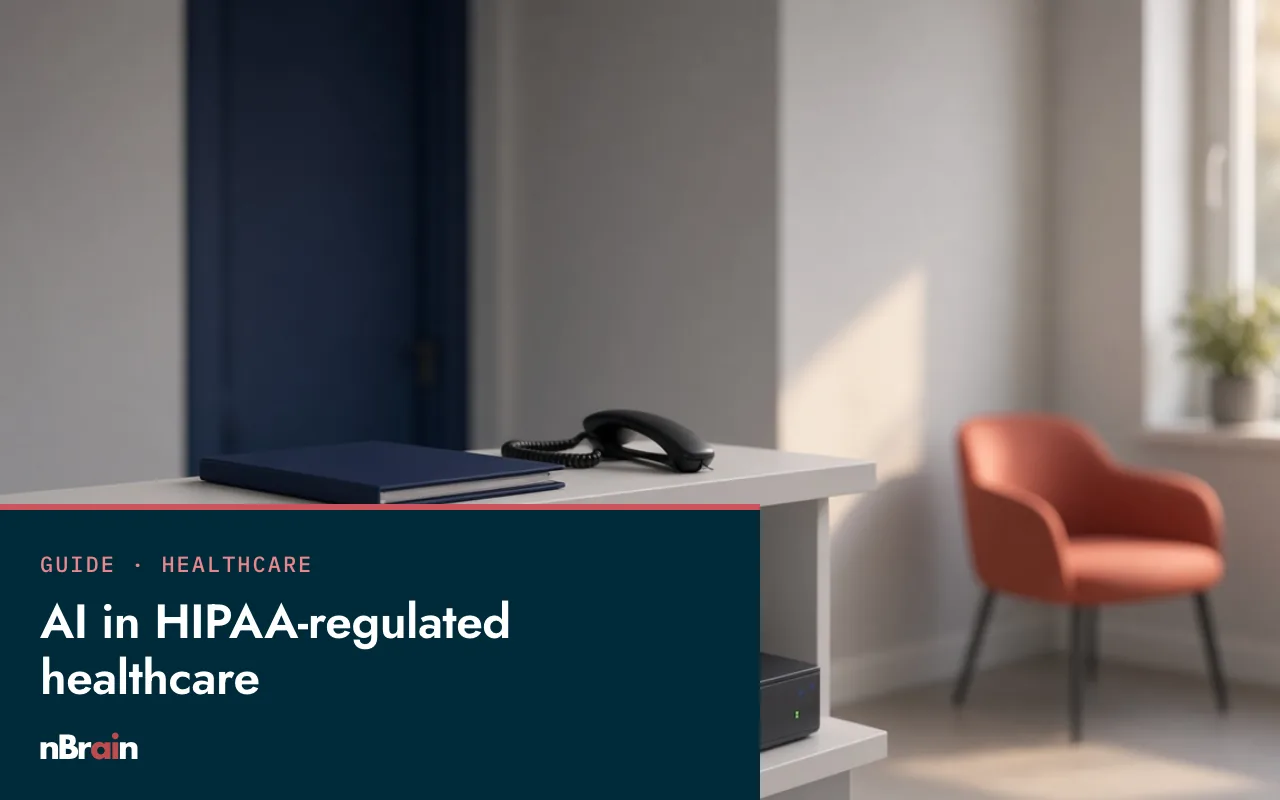
Use AI on patient-facing work, without making a reportable disclosure.
A plain-language guide for practice owners and compliance leads: what a BAA covers, which model providers offer one, how a compliant system is built, which use cases are safe to start with, and which to avoid.
Built for the work healthcare operators actually do.
Each team starts with one costly, everyday job. The Brain does the searching, matching, and first drafts. Clinicians and staff make every clinical, billing, and patient-facing decision.
AI for scheduling and patient access
Book the right slot the first time, with fewer calls on hold.
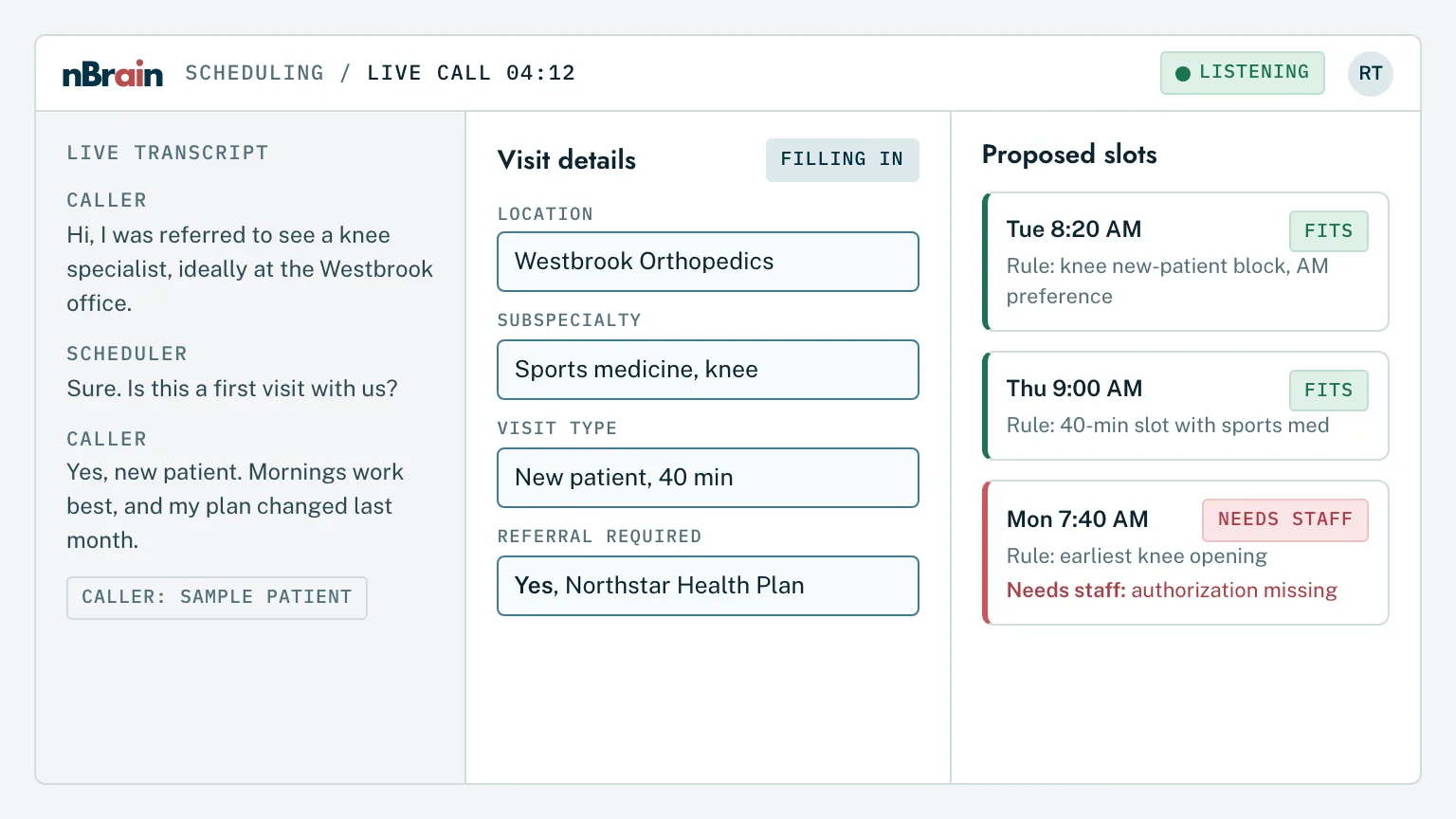
Specialty schedulers juggle location, subspecialty, referral and authorization rules, and each provider's preferences on every call. The Brain listens to the call as it happens, fills in the scheduling fields, and proposes slots that fit the rules. The scheduler confirms the booking.
Fields filled while the patient talksA live transcript fills in visit type, location, and insurance, so the scheduler checks instead of typing.
Rules applied, not memorizedProvider preferences, referral requirements, and multi-complaint rules come from your playbook, not from the newest hire's memory.
Unclear cases go to a personMissing insurance, an unverifiable plan, or a clinical question is routed to staff with the call summary attached.
AI proposes, a person confirms. The AI proposes the slot and a scheduler confirms it. Their confirmations then become the training data.
Find the denial pattern, not just the denied claim.
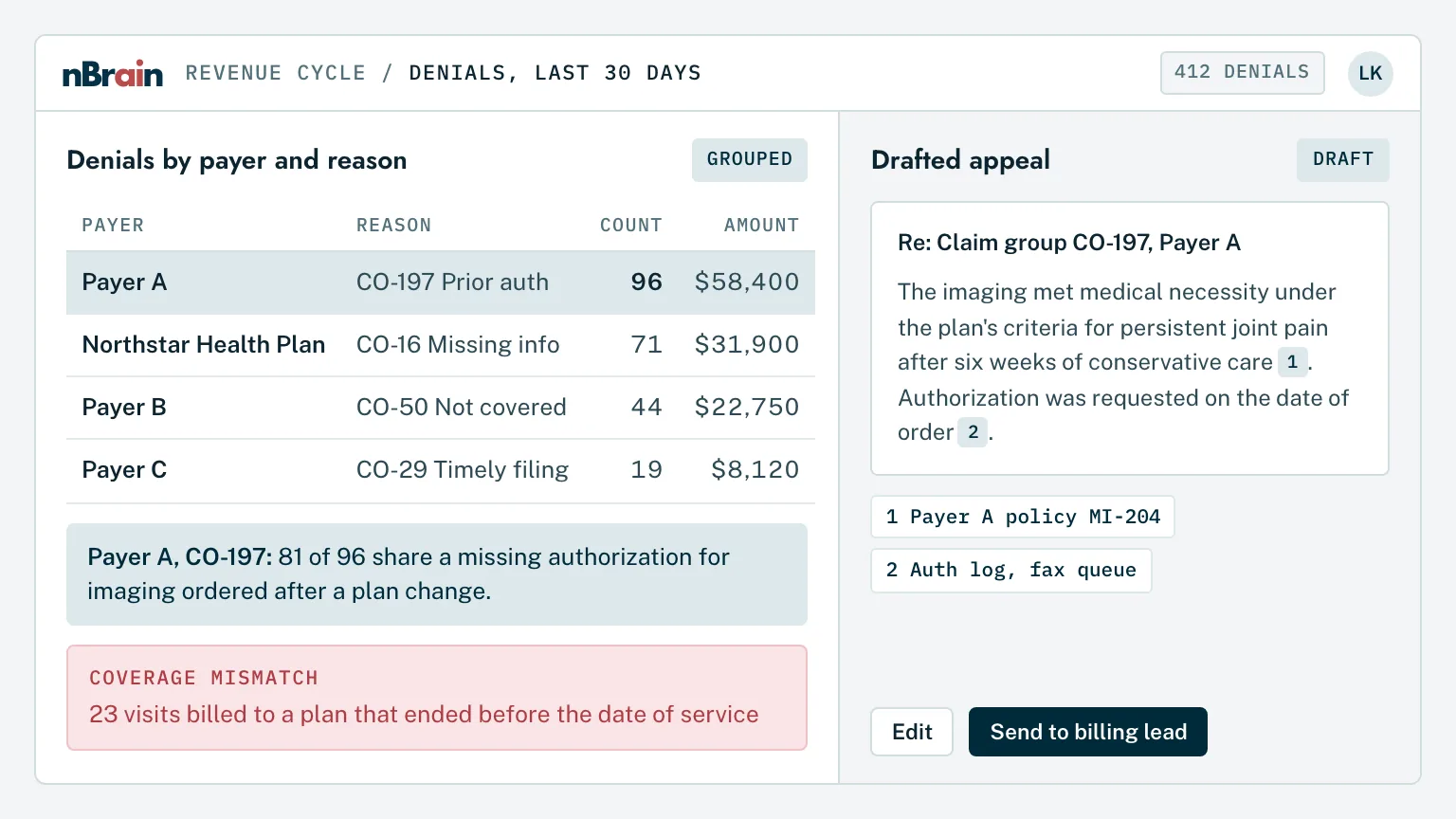
The Brain reads remits, claims, and payer rules together. It groups repeat denials by cause, flags claims filed under a different insurer than the one in the clinical record, and drafts prior-auth letters and appeals from the chart for your billing team to finish.
Repeat denials grouped by causePayer, code, and reason rolled up, so the fix happens once instead of claim by claim.
Coverage mismatches caught earlyThe insurer on the clinical record compared to the one on the claim, before the claim goes out.
Prior-auth and appeal draftsLetters drafted from the payer's own policy and the documentation in the chart, with each criterion cited.
Your billers submit. The Brain drafts and flags. Coding decisions and submissions stay with your revenue cycle team.
The answer a nurse needs at 4 a.m., without calling three people.
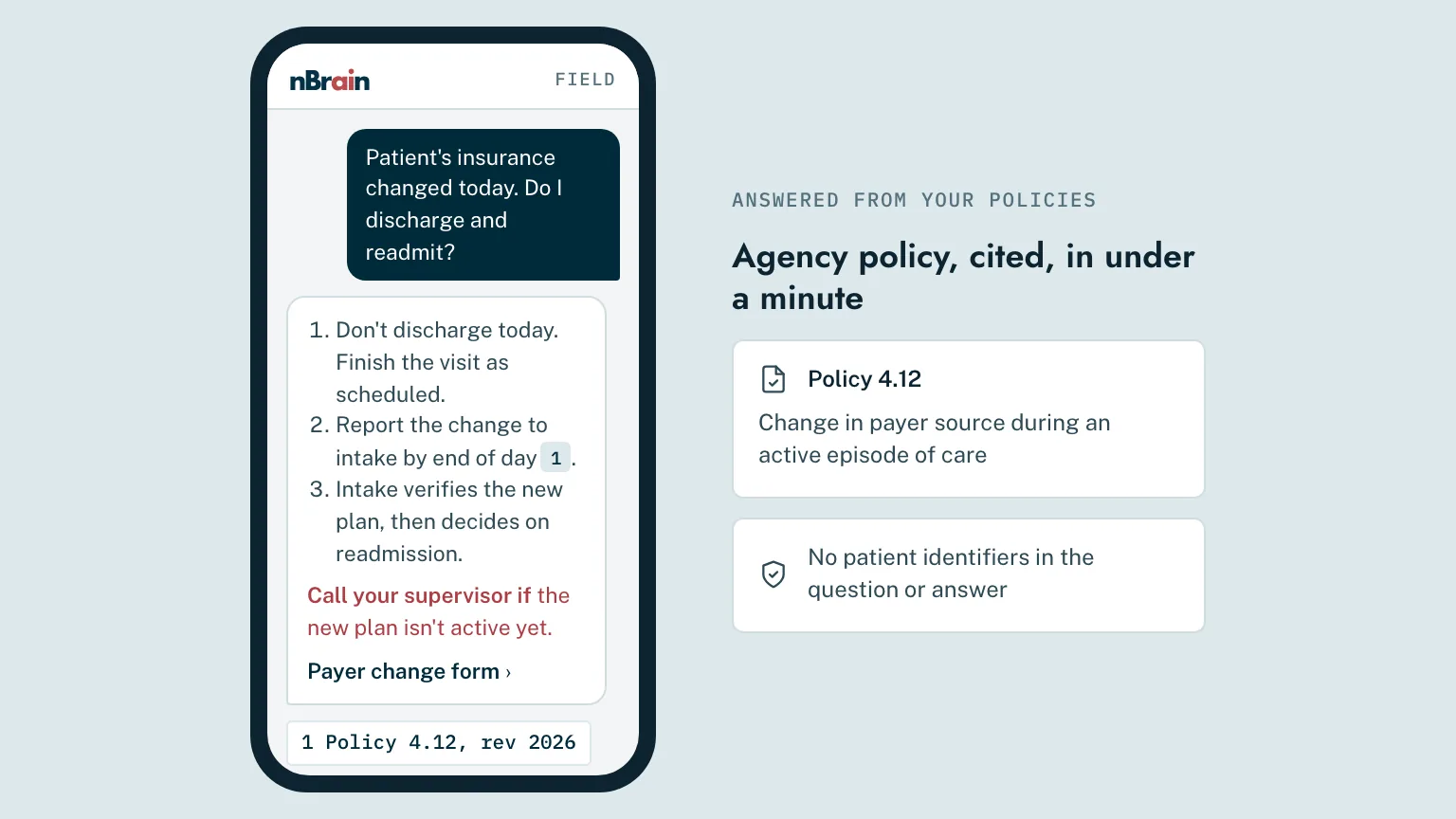
Home health, hospice, and PACE staff ask operational questions in plain English, by text, email, or chat. The Brain answers from your policies, payer rules, and training, links the exact source, and says “I don't have this” instead of guessing.
Playbooks that travel with the nurseWhat to do after an insurance change, which form applies, and who to call, all from your own procedures.
Documents findable when it mattersSigned forms and directives on file, surfaced for the staff allowed to see them.
Training in the moment of careThis week's training and documentation standards, available on the visit, not only in the classroom.
Operational answers, not clinical judgment. The Brain points to your policy. Clinical decisions stay with licensed staff, and anything uncertain is escalated to a supervisor.
Answer every referral fast, with the right program and the right words.
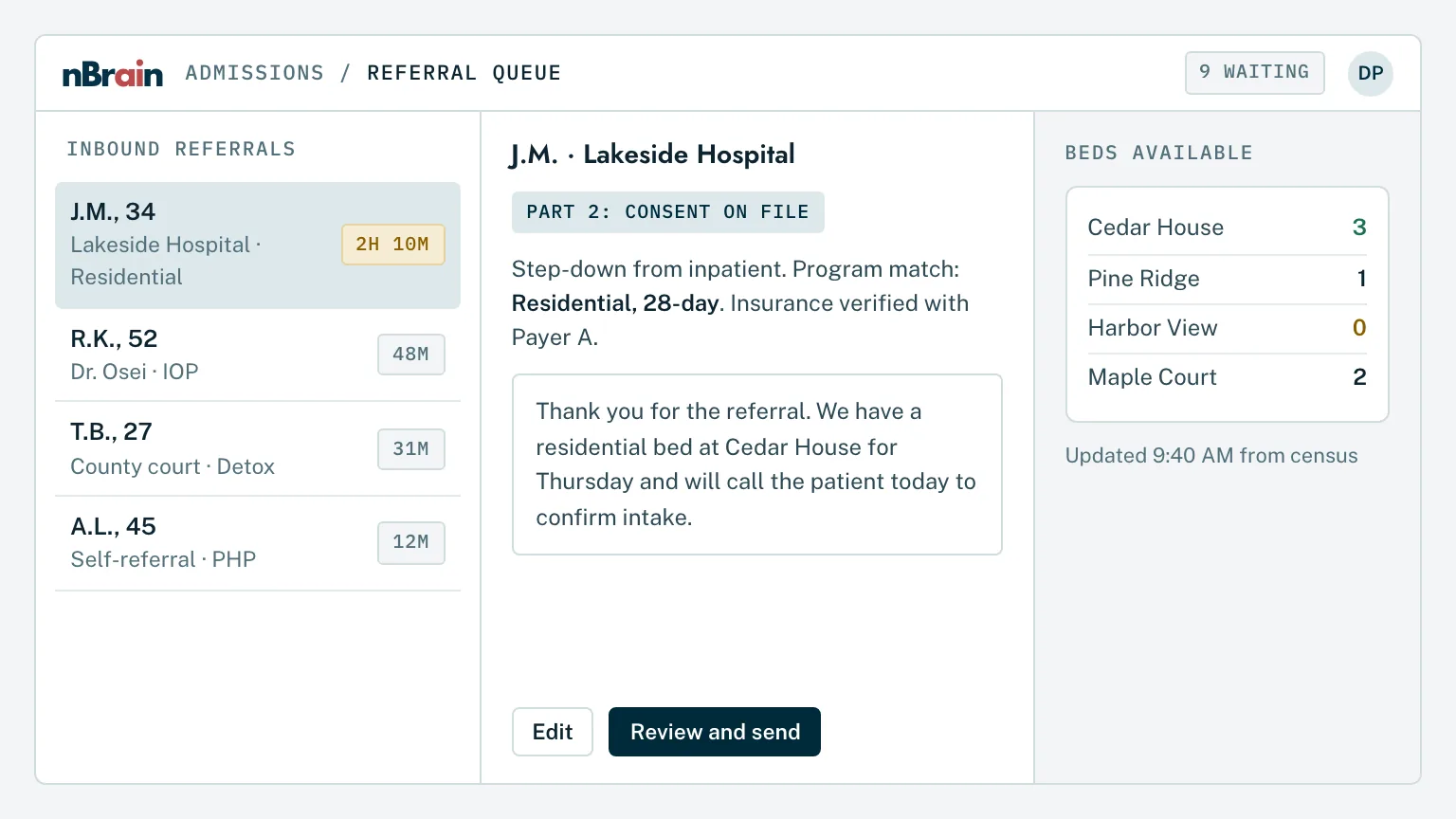
Residential and outpatient programs lose referrals when families and partners wait. The Brain summarizes each inquiry, checks program fit and current availability, and drafts a reply in your approved tone for admissions to send.
Referral triageInquiries summarized and matched to program criteria and open beds across locations.
Approved family and partner repliesDrafts that use your program details and messaging guardrails, reviewed before they go out.
Part 2 records kept separateSubstance use disorder records tagged at intake and only used where consent allows.
Admissions decides. Program fit, clinical appropriateness, and anything said to a family stay with your admissions and clinical team. We don't have a behavioral health client story yet.
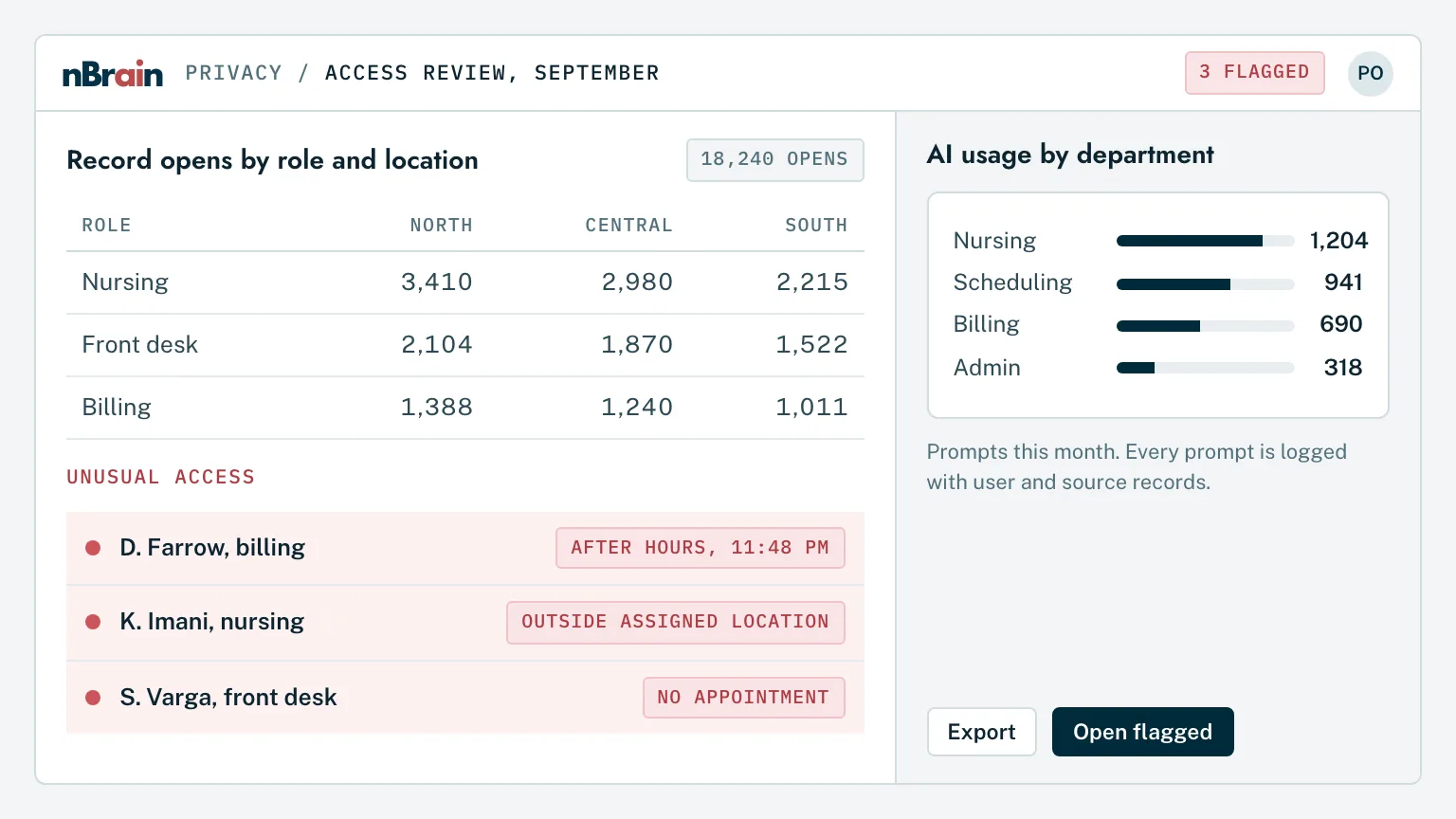
Your staff are already pasting work into consumer AI tools. The Brain gives them a sanctioned alternative that keeps PHI in your account. It also gives your privacy officer the access reviews, policy answers, and audit evidence that used to take a week to gather.
One sanctioned AI toolLogged, permission-aware, and inside your boundary, so “don't use ChatGPT” comes with somewhere else to go.
Access reviews draftedWho opened what, by role and location, with unusual access flagged for your privacy officer.
Policy questions answered with the citationStaff ask about HIPAA, consent, or release-of-information rules and get your policy, quoted and linked.
Your privacy officer decides. The Brain gathers and drafts. Findings, sanctions, and breach determinations stay with your compliance team.
Less coordinator admin, with study data kept in bounds.
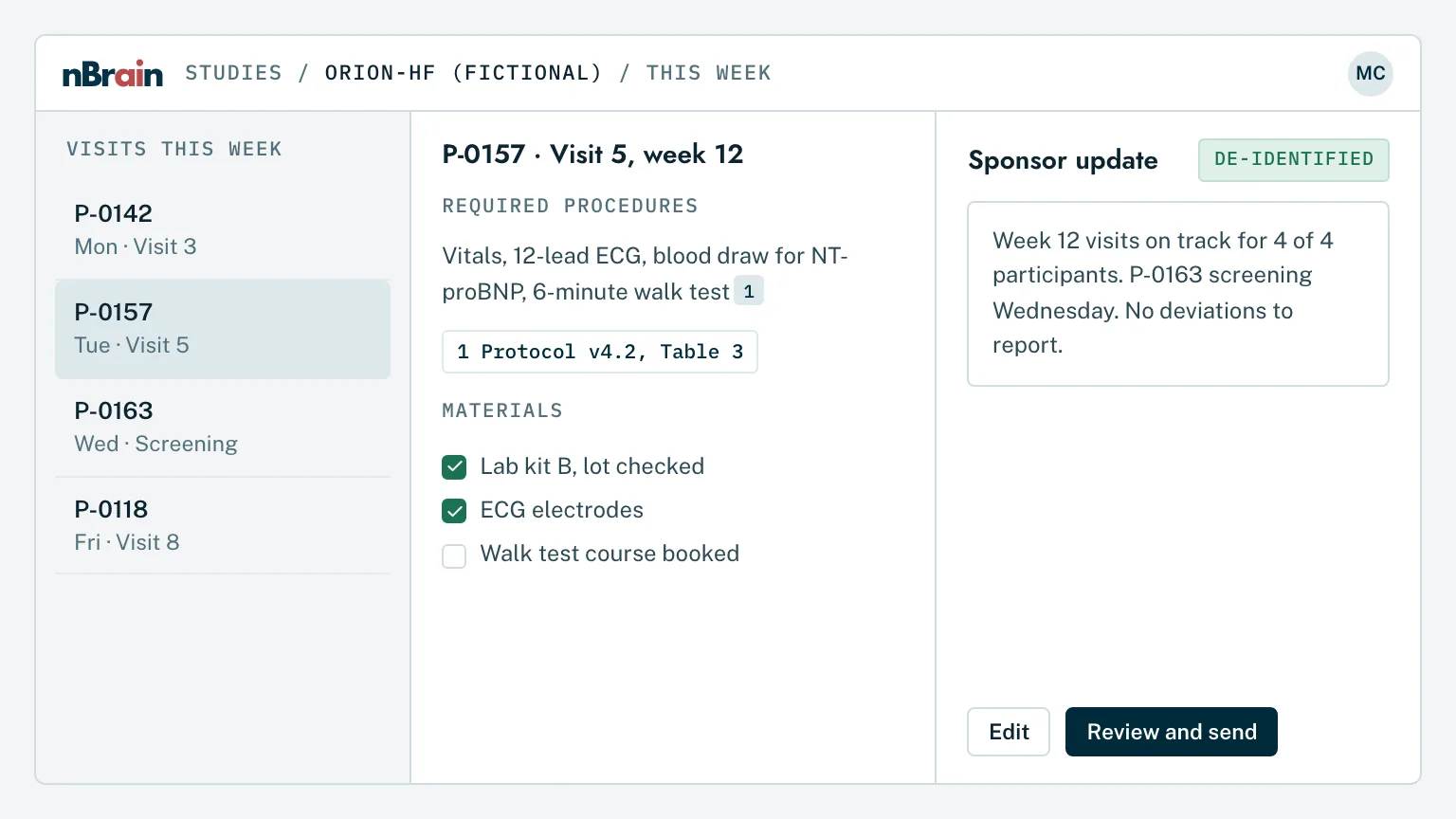
Coordinators keep studies moving across protocols, participants, sponsors, and calendars. The Brain answers protocol and SOP questions with the section cited, preps each visit, and drafts sponsor updates and enrollment summaries from approved sources.
Protocol Q&A with the section citedVisit windows, eligibility criteria, and procedures answered from the current protocol version.
Visit prep in one viewRequired procedures, materials, and open tasks for each upcoming visit.
De-identified by defaultSponsor reports and summaries drafted from de-identified data, with identifiers kept in your environment.
Your investigators and IRB stay in charge. Eligibility calls, protocol deviations, and anything sent to a sponsor are reviewed by the study team. No research client story yet.
Regulatory documents drafted from your own design history.
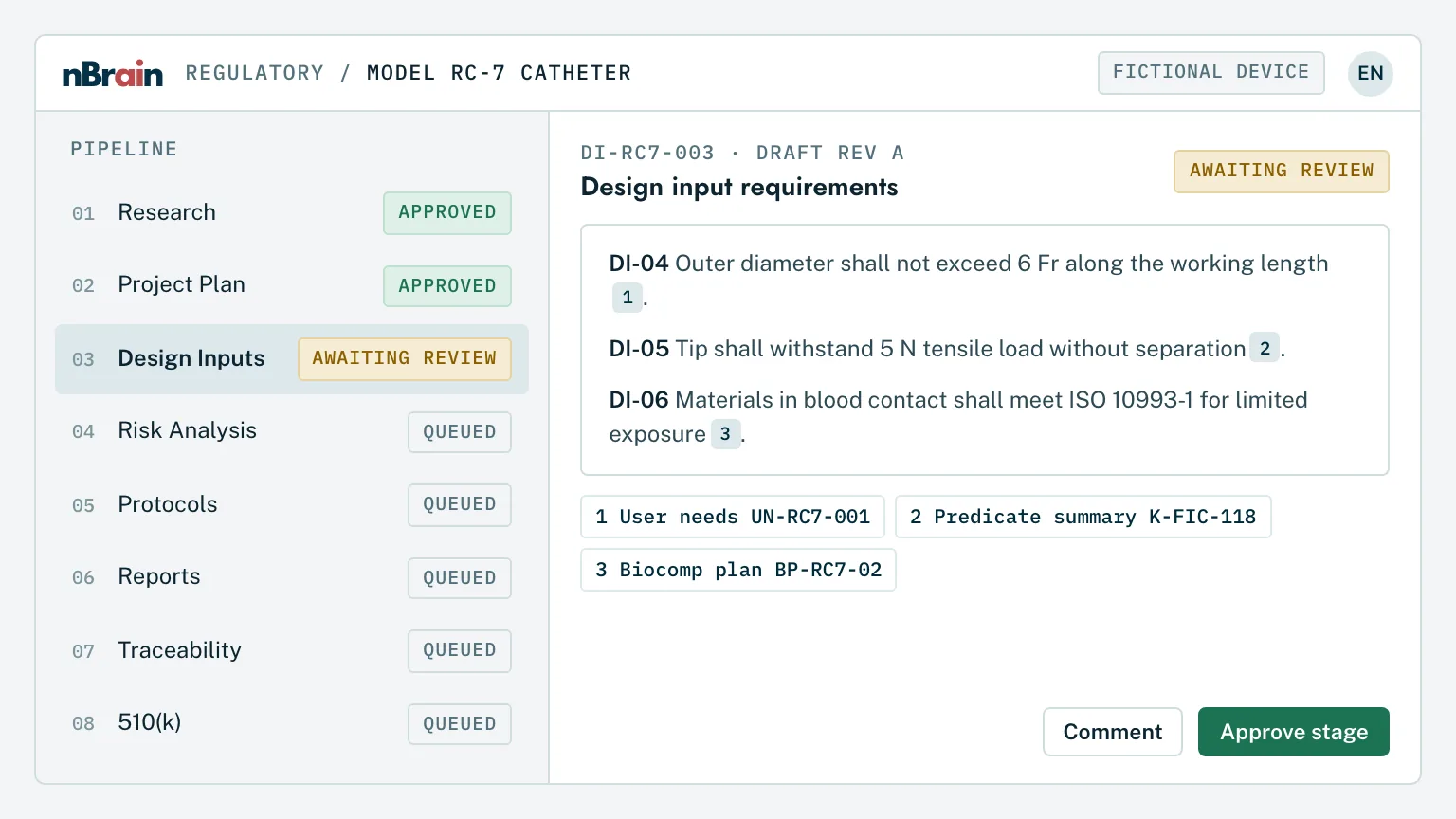
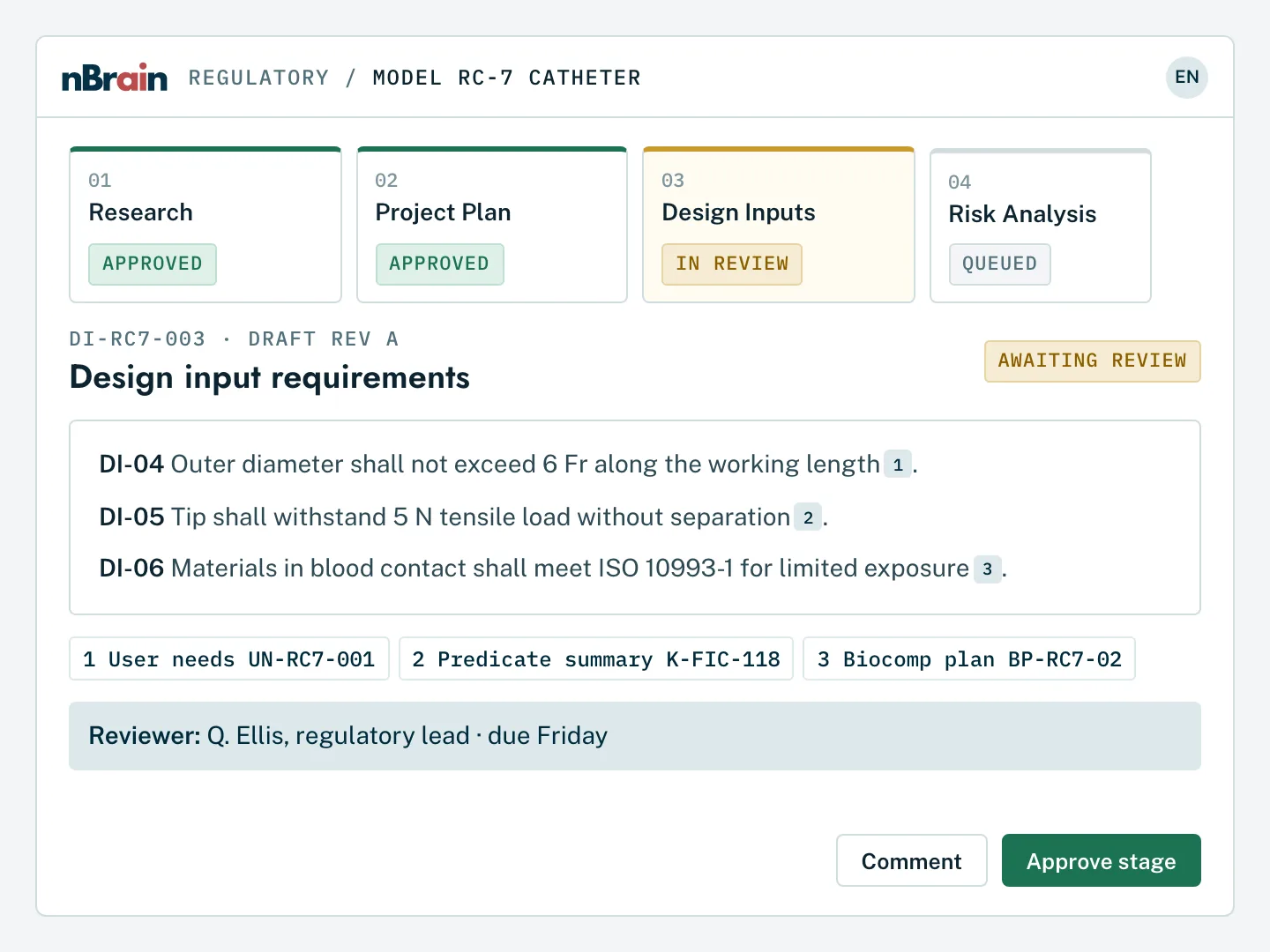
Device and health tech teams spend weeks assembling design inputs, risk analyses, protocols, and 510(k) sections by hand. The Brain researches FDA public databases, drafts each document in your controlled templates under your SOPs, and holds every draft for human review before the next step runs.
Research from FDA sourcesPredicate devices, adverse event reports, product codes, and guidance pulled from FDA databases and cited.
Your templates, your numberingDrafts match your controlled forms, document numbering, and approval structure.
A human gate at every stepReviewer redlines are fed back so the next draft improves, and every generated document is logged by user.
Running today. A medical device reprocessing company runs this pipeline inside its own Azure account. Read the story →
One answer across every location, and every location you add.
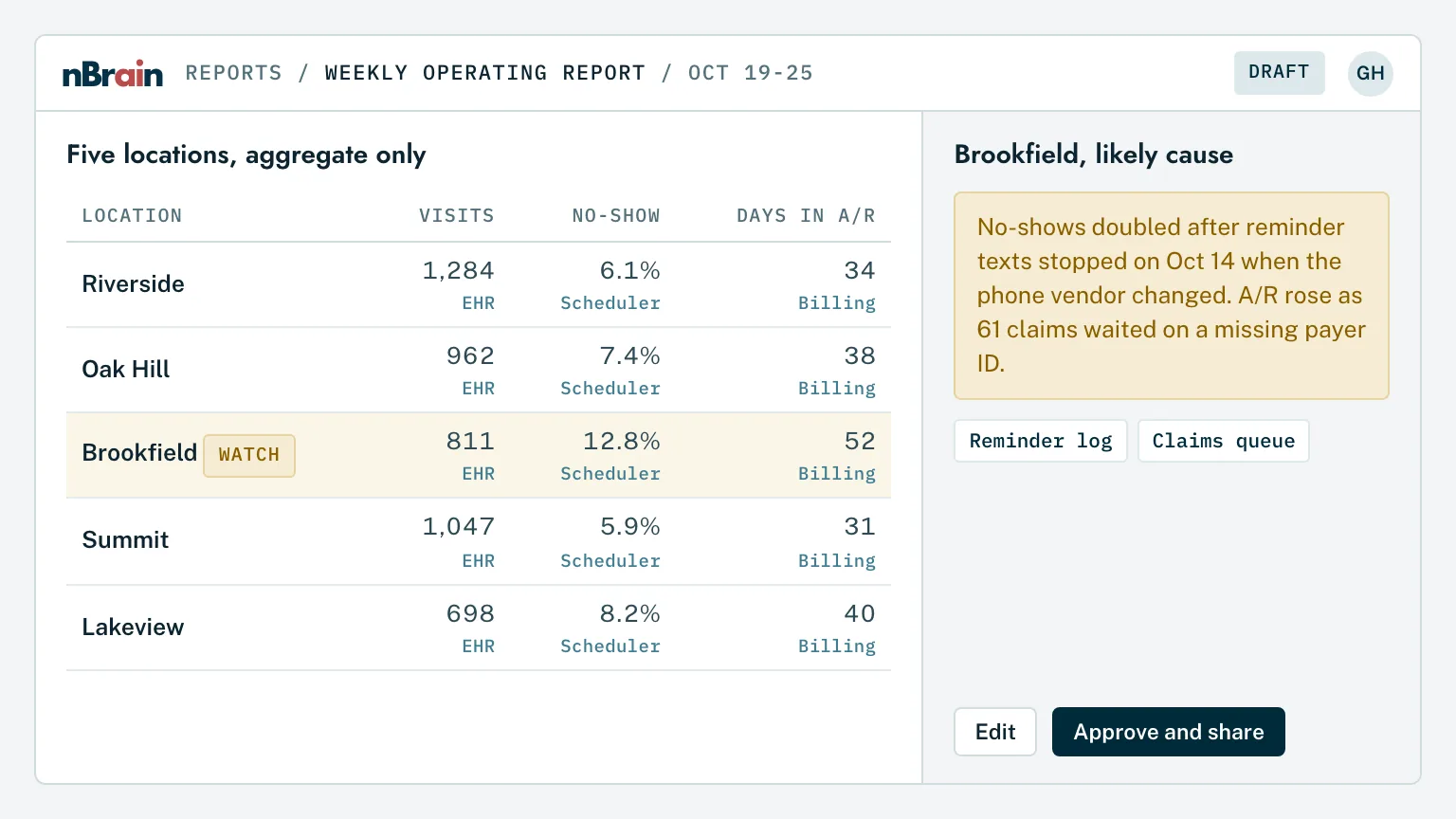
Groups that grow clinic by clinic, or by acquisition, end up with a different process, login, and spreadsheet at each site. The Brain gives every location the same policies, playbooks, and reporting, and gives leadership one view across all of them.
Consistent answers across sitesPolicies, forms, and referral instructions answered the same way at every location, by role.
Weekly operating reportsVolume, no-shows, staffing, and collections drafted from your systems for the operator to review.
Acquisitions onboarded fasterA new location's staff get your playbooks, training, and “where do I find this” answers from day one.
One Brain, built inside your environment, one workflow at a time.
Your systems feed one knowledge layer. The Brain routes each task to the right model and works in the tools your staff already use, under the rules you set.
Step 01
Deploy
Set up in your HIPAA-eligible Azure or AWS account, or on your own servers.
Your identity provider and roles
Encryption in transit and at rest
Only HIPAA-eligible services near PHI
Step 02
Connect
Your EHR, practice management, phone, and billing systems, read-only by default.
FHIR APIs, HL7 feeds, or scheduled exports
Microsoft 365, SharePoint, and file shares
Clearinghouse and payer portals where allowed
Step 03
Act, with approval
Agents search, draft, check, and route. A person approves anything that reaches a patient, payer, or chart.
Approval queues by role
Citations on every answer
Low-confidence answers flagged
Step 04
Measure and expand
We take a baseline in month one, then add the next workflow on the same data and permissions.
The first questions a practice owner or CISO asks are where patient data goes, who can see it, and what happens when the AI is wrong. These controls are built in from the first week.
Runs inside your environment
Deployed in your HIPAA-eligible Azure or AWS account or on-prem, so PHI stays inside the boundary you already secure.
Minimum necessary, enforced
Role-based access mirrored from your identity provider and source systems, checked on every request.
De-identified where it can be
Identifiers stripped or tokenized before a model sees the text, wherever the task allows. PHI never trains public models.
Approval gates
Anything sent to a patient, payer, or partner, and any change to a record, waits until the right person approves it.
A full audit trail
Which data, which model, which person, and which action, recorded every time and kept on your retention schedule.
Built for HIPAA-regulated environmentsAzure HIPAA-eligible servicesAWS HIPAA-eligible servicesOn-premises or isolatedDesigned to support the HIPAA Privacy and Security RulesPHI never trains public models
What we do and don't claim. No AI product is HIPAA certified, because no such certification exists. nBrain does not hold a SOC 2 report or HITRUST certification. The Brain deploys inside an environment you already secure and that is covered by your cloud provider's BAA, so it sits within your existing safeguards. We sign a BAA where PHI is involved. We document the architecture and controls to support your HIPAA risk analysis and any vendor review.
Each agent has one job, a defined set of tools, and guardrails on what it can do. They share the same data, permissions, and audit trail, so each new one ships faster than the last.
Patient access
Scheduling assistant
Fills scheduling fields from the live call and proposes slots that fit your rules.
Intake
Intake packet prep
Lists missing forms, referrals, and insurance details before the visit.
Revenue cycle
Prior-auth and appeal drafter
Drafts letters from the payer's criteria and the chart, for billers to finish.
Revenue cycle
Denial pattern finder
Groups repeat denials by payer and cause, and flags coverage mismatches.
Care teams
Policy and protocol Q&A
Cited answers from your policies and training, by text, email, or chat.
Admissions
Referral responder
Summarizes inquiries, checks program fit, and drafts approved replies.
Compliance
Access review assistant
Drafts monthly access reviews and flags unusual record opens.
Research & regulatory
Regulatory document drafter
Drafts protocols, risk analyses, and submission sections in your templates.
One Brain running in health tech today, the platform proof behind it, and the provider story we're building next.
Health tech · Medical device reprocessing
Regulatory documents drafted from 130+ controlled records, inside the company's own Azure account.
The problem
The R&D team assembled design inputs, risk analyses, validation protocols, and 510(k) sections by hand for every device, following strict SOPs, controlled templates, and a set document-numbering system.
What we built
An eight-agent pipeline: research, project plan, design inputs, risk analysis, protocols, reports, traceability, and 510(k) compilation. It researches FDA public databases, learns from the company's own approved history, and drafts each document in its controlled templates.
How it's governed
Runs in the company's Azure account, behind its single sign-on. A person reviews every draft before the next agent runs, and every generated document is logged by user. Reviewer redlines are fed back so the next draft improves.
Who owns it
The company owns the storage, the data, and the code. Its team is now taking on day-to-day changes itself, with the source code in hand.
8
agents in one governed pipeline, each with a human review step
130+
controlled documents analyzed to match its SOPs and templates
The same platform, already running in a security-restricted industry.
A Tier 2 defense manufacturer runs finance, the factory floor, and engineering on one private Brain, with the same permissions, approvals, and audit trail a healthcare Brain uses.
92%
less sales-team time on RFQs
33.5%
average productivity increase within six months, across nBrain clients
Hours returned to the front desk and the billing team.
The first provider Brain we take live will be written up here, with the baseline taken in month one and the results measured against it.
Client names are withheld except where the client has agreed to be named. No patient data appears in any story.
Straight answers
The questions healthcare leaders ask us first.
Is nBrain HIPAA certified?
No, and nobody else is either. There is no official HIPAA certification for any company or product. HIPAA is a set of rules that covered entities and their business associates comply with. The Brain is built for HIPAA-regulated environments: it runs inside your HIPAA-eligible cloud account or on your own servers, enforces minimum-necessary access, logs every access, and keeps PHI away from public models. Be cautious of any AI vendor that says it is “HIPAA certified.”
Will you sign a BAA?
Yes, where PHI is involved, and before any PHI moves. Your cloud provider's BAA covers the infrastructure the Brain runs on, because it runs in your account. Any model that sees PHI is reached through an endpoint covered by a BAA, such as Azure OpenAI, Amazon Bedrock, or Google Vertex AI. Many first workflows, such as policy Q&A, payer rules, and staff training, don't involve PHI at all.
Does patient data go to OpenAI, Anthropic, or Google?
Not to their consumer apps or public services, and never to train their models. When a task needs GPT-6 Astra, Claude Opus 5.5, or Gemini 4 Argon and involves PHI, the call goes through a BAA-covered endpoint in your own cloud account, such as Azure OpenAI or Amazon Bedrock, with no training on your data. Where the task allows, identifiers are stripped before the model sees the text. For anything you don't want leaving your hardware, open-weight models run in your environment. You decide which models may see which data, and every call is logged.
Where does it run?
In your own HIPAA-eligible Azure or AWS account, on servers in your own data center, or on an isolated network for the most sensitive data. It is not an nBrain-hosted SaaS your data has to travel to. You own the platform, the data, the prompts, the agents, and the code.
How does it enforce minimum necessary?
Access mirrors your identity provider and the permissions in each source system, and it is checked on every request. Each agent is also scoped to the fields its job needs. A scheduling agent sees appointment and insurance fields, not clinical notes. Permission changes and every record access are logged for your privacy officer.
Can it de-identify data?
Yes. Identifiers can be stripped or replaced with tokens before a model sees the text, and the real values stay in your environment. For research and reporting, outputs can be built from de-identified data, following HIPAA's Safe Harbor method or an expert determination you commission. Your privacy officer decides which method applies.
Does the AI make clinical decisions?
No. The Brain handles operational work: searching, drafting, checking, and routing. Diagnosis, treatment, prescribing, eligibility, and anything said to a patient stay with licensed staff. It is built to be wrong safely. Answers cite their sources, low-confidence answers are flagged, and anything that reaches a patient, payer, or chart waits for a person to approve it.
How do you handle bias and patient consent?
Before go-live we test each workflow on your own records and, where it matters, review results across patient groups, so you can see where performance differs. Your consent language is built into the workflow. For example, patients get notice before a call is recorded or transcribed, and Part 2 records are only used where consent allows.
Who at nBrain can access our data?
Only the engineers working on your Brain, through accounts you issue inside your environment, for the scope and time you grant. You can revoke access at any time, and every session is recorded in your audit trail. The Brain's data stays in your environment, and PHI never goes through nBrain's own portal or email.
Do you hold SOC 2 or HITRUST?
Not today. Because the Brain runs inside your environment rather than ours, it falls under the safeguards and audits you already have. We provide the architecture, data-flow diagrams, and control descriptions your security team or vendor-risk review will ask for. If your organization requires SOC 2 or HITRUST from vendors, tell us early and we'll walk through how the deployment model answers it.
Which systems can it connect to?
EHR and practice management systems through FHIR APIs, HL7 feeds, or scheduled exports, where the vendor allows access. It also connects to phone systems and call recordings, billing and clearinghouse data, Microsoft 365, SharePoint, file shares, and databases. Anything without a connector is built as part of the engagement. Vendor API access, and what it costs, is one of the first things we check.
What does it cost?
Builds start at $40,000, and a typical build takes about three months. Running costs, meaning your own cloud and model accounts, are billed to you directly at list price with no markup. Because the orchestrator sends each task to the right model, model usage typically costs about 65% less than sending everything to the largest model.
Where should a practice or health system start?
With one high-volume workflow that needs little or no PHI, such as policy and payer-rule questions, staff training, or denial patterns. Scheduling, intake, and documentation drafts come next, once the PHI controls are in place and your privacy officer has reviewed them. We take a baseline in month one and measure hours returned, then add the next workflow on the same foundation.
Put private AI to work on healthcare data, inside your own environment.
In one strategy session we map where a Brain would give your staff the most time back, which workflows can start without PHI, and what your privacy officer and security team will want to see.