Measure the impact

See what a private AI Brain could give back to your team. Your numbers, every assumption shown.

Enter your headcount and pay, set how much time you expect the Brain to return, and see the hours, the value of that time, and what model routing saves on AI usage. It's an estimate for planning. We replace it with your real baseline in month one.

Builds start at
$40,000
scoped with you before anything starts
Typical build
~3 months
to the first workflows in daily use
Running costs
List price
in your own cloud and model accounts, no markup
Model cost
~65% lower
per task, through model routing
Your inputs

Tell us about your team

Every field changes the estimate on the right. Defaults are typical for a mid-market company.

employees
$

Per employee, per year.

hrs

A normal working week.

35%
5%Conservative · Typical · Aggressive60%

Share of each person's week the Brain takes on: searching, drafting, matching, re-keying. Our customers average a 33.5% productivity increase within six months.

$/mo

What model usage would cost without routing.

65%

Lower cost per task from routing each task to the right model.

Estimated value returned each year, once live
$714,750
Builds start at $40,000 and typically take about 3 months
350
hours returned to your team every week
$656,250
value of time returned each year
$58,500
saved on model usage each year
8.8
full-time roles of capacity returned
First year: return vs. investment18x the build cost

First-year return counts 12 months of value at the run rate once workflows are live. At that rate the build cost is covered by about 3 weeks of returned value.

These are estimates for planning, not a guarantee. Real results depend on the workflows in scope, how fast your team adopts them, and the baseline we measure with you in month one. Build cost varies with scope and starts at $40,000. Model and cloud usage run in your own accounts at list price, with no markup.

Get an estimate built on your workflows

What a private AI Brain has done for nBrain customers.

92%
less sales-team time on RFQs at Regal Technology Partners, a Tier 2 defense manufacturer
5months
from first idea to a Brain built and launched across a 200-person manufacturer
65%
lower cost per AI task, because the orchestrator sends each task to the right model
33.5%
average increase in employee productivity within six months

Results from Brains running for nBrain customers. Read the customer stories →

Methodology and assumptions

How the estimate works, in plain language.

No black box. Here is every assumption the calculator uses, why we chose the default, and the three formulas behind the numbers.

Assumption
Default
What it means and why
People using the Brain
25
Everyone who will use it in their daily work. Start with the teams in the first build, not the whole company.
Average salary
$75,000
Base pay per person per year. We use salary, not fully loaded cost, so the estimate leans conservative.
Hours per week
40
A standard working week. Used to turn the time-returned share into hours and full-time roles.
Time returned
35%
The share of each person's week the Brain takes on once their workflows are live: searching across systems, drafting, matching documents, re-keying data, and status reporting. Our customers average a 33.5% productivity increase within six months, so 35% is a typical planning figure, not a ceiling or a promise. Set it lower for teams with little document or system work.
AI usage per employee
$300 / mo
What frontier-model usage would cost per person if every task went to the most expensive model. Heavy users cost more, light users less.
Model savings
65%
The Brain's orchestrator sends each task to the model that does it well at the lowest cost, including private open-source models for routine work. That has lowered cost per task by about 65%.
Build investment
$40,000
Builds start at $40,000 and typically take about 3 months. The real figure depends on the use cases in scope, and we scope it with you before anything starts.
Value of time returned
people × salary × time returned

Hours per week = people × hours × time returned. Full-time roles = hours returned ÷ hours per week.

Model savings
people × usage per month × 12 × model savings

What routing saves against sending every task to one top-tier model.

First-year return
time value + model savings

Twelve months of value at the run rate once workflows are live, the same figure the home page shows. Compared against the build investment.

What the estimate does not do
  • It isn't a guarantee. It shows what the time is worth if the Brain takes on that share of the work. Your real number comes from the baseline we take with you in month one.
  • Returned time isn't cash saved. Most owners put it back into growth, service, and work that was getting skipped, rather than cutting roles. The value shown is what that time costs you today.
  • Adoption ramps. Teams reach full use over weeks, not on day one, and some roles gain far more than others.
  • Running costs are separate. Cloud and model usage run in your own accounts at list price, with no markup. The model-savings line reflects the reduction routing brings to those costs.
Where the time comes from

The hours come from work your people do every day.

Time comes back from the searching, matching, drafting, and re-keying that sits between the decisions. The Brain does that part. Your people keep the judgment calls.

Finance

The Brain prepares
  • Invoices pulled from the mailbox and matched to POs and receipts
  • Vendor statements reconciled and exceptions queued
  • Month-end variance notes drafted from the ledger
A person still
  • Approves every payment and banking change

Sales and quoting

The Brain prepares
  • RFQs and drawings decoded into parts and costs
  • Proposals drafted from call transcripts and past wins
  • CRM updated from calls and email
A person still
  • Sets pricing and makes the bid decision

Operations

The Brain prepares
  • Which jobs can start today, and what's blocking the rest
  • Status reports pulled from ERP and project systems
  • Supplier certs checked against the PO and spec
A person still
  • Releases work and commits dates to customers

Customer service

The Brain prepares
  • Answers drafted from your policies, history, and records
  • Calls and tickets summarized and routed
  • Follow-ups drafted from what was promised
A person still
  • Sends anything that goes to a customer

HR and training

The Brain prepares
  • New-hire questions answered from SOPs and past answers
  • Training and certification tracking
  • Expert know-how captured before people retire
A person still
  • Owns hiring, reviews, and policy

Leadership

The Brain prepares
  • Meeting prep from the full client or project history
  • Commitments from calls turned into tracked tasks
  • One answer across every system, in plain English
A person still
  • Sets priorities and makes the calls

Examples drawn from Brains we've built across manufacturing, finance, healthcare, and professional services. Which ones apply to you is the first thing we work out together.

The long-term payoff

The calculator shows year one. The value keeps building.

The platform is built inside your company, not rented from a vendor. Every month of learning stays with you, and every new workflow reuses what's already built, so the second and third cost less and ship faster than the first.

Owned vs. rented · where the value builds
VALUE TO YOUR COMPANY AS IT LEARNS YOUR BUSINESS AND NEW MODELS PLUG IN → VENDOR UPDATES · SAME FOR EVERY CUSTOMER YOUR COMPANY KNOWLEDGE Your Brain, owned Compounds on your own data Agent sophistication Smarter with every use Rented SaaS Shared with every customer FEEDBACKMEMORYTUNING GPT-6 AstraClaude Opus 5.5Gemini 4 ArgonNext model VALUE TO YOUR COMPANY AS IT LEARNS AND NEW MODELS PLUG IN → Your Brain, owned Agent sophistication Rented SaaS SAME UPDATES, EVERY CUSTOMER FEEDBACKMEMORYTUNING GPT-6 AstraClaude Opus 5.5Gemini 4 ArgonNext model
Your Brain, owned. Your company knowledge (decisions, answers, approvals, history) compounds, and it steps up with every new model, with no rebuild. Agent sophistication. Your agents get smarter with every use: each correction is feedback, they remember past work, and they are tuned on how your team works. Rented SaaS. Improves when the vendor ships, for every customer equally. Your feedback doesn't build agents you own, and the value stays with the vendor. Illustrative, not to scale.

Intelligence that compounds

Every decision, answer, approval, and piece of history the Brain learns stays in it and sharpens the next answer.

An asset you own

It sits on your books, not a vendor's. Its value builds the longer it runs. That is hard to put a number on today, but it is yours.

Better with every new model

GPT-6 Astra, Claude Opus 5.5, Gemini 4 Argon, and whatever ships next plug into the same Brain. No rebuild, and nothing it has learned is lost.

Learning no competitor can rent

Rented AI ships each improvement to every customer, your competitors included. What your Brain learns from your work stays with you.

What we measure in month one

Your real number replaces this estimate.

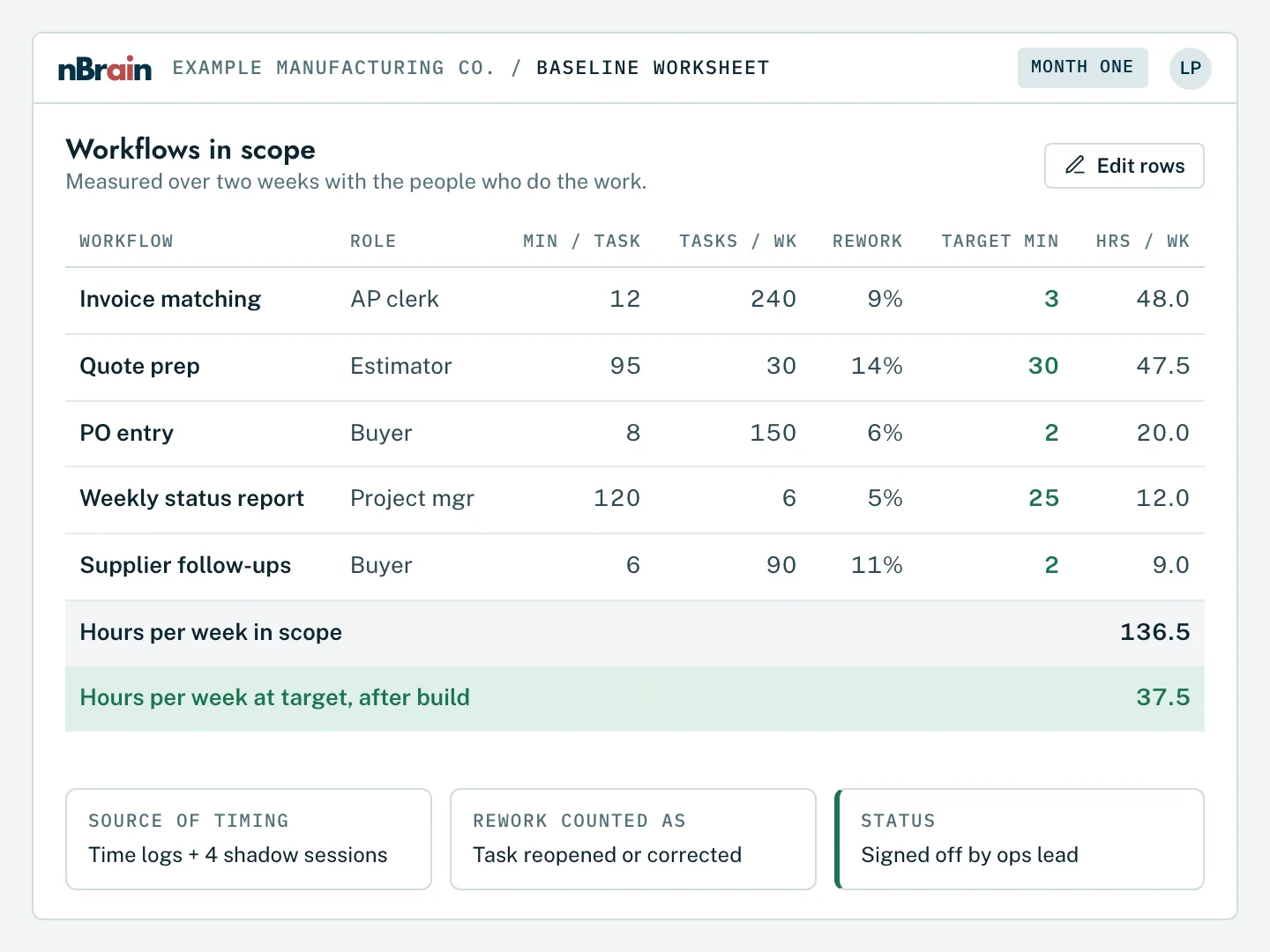
Before we build, we sit with the people who do the work and time it. That baseline is what every result is measured against, and what you hold us to.

  • Hours per task, by roleHow long the work in scope takes today, timed with the people who do it.
  • Cycle timeHow long a quote, invoice, report, or request takes from start to done, including waiting.
  • Errors and reworkHow often work is redone or caught late, and what that costs.
  • Current AI spendWhat you pay for AI seats and usage today, so savings are measured, not assumed.
  • A written definition of doneThe one or two numbers that prove each workflow worked, agreed before build.
How we report results every month →
Example month-one baseline worksheet listing workflows with role, minutes per task, tasks per week, rework rate, target minutes and total hours per week in scope.
The investment

Clear costs, in your own accounts.

One build fee, scoped with you before anything starts. Running costs are yours, billed by your cloud and model providers at list price.

Builds start at
$40,000
A typical build takes about 3 months to the first workflows in daily use.
  • Scoped before it starts. The build fee depends on the use cases in scope, and you see it before you commit.
  • Running costs at list price. Cloud and model usage are billed directly to your own accounts, with no markup from us.
  • About 65% lower model cost. Routing sends each task to the right model instead of the most expensive one.
  • Yours to keep. The code, data, prompts, and agents belong to you, and keep running if you take it in-house.
Straight answers

Questions owners ask about the return.

Is the return guaranteed?

No, and you should be wary of anyone who guarantees one. The calculator shows what the time is worth if the Brain takes on that share of the work. In month one we measure your real baseline, agree on the numbers that prove each workflow worked, and report against them every month.

Why 35% time returned?

It's a planning figure close to what we've seen: our customers average a 33.5% increase in employee productivity within six months. Teams that spend most of the day in documents, email, and systems tend to see more. Roles that are mostly hands-on or face-to-face see less. Move the slider to match your teams.

How fast does the value start?

A typical build takes about three months, and the first workflows are usually in daily use before the build finishes. The first-year figure counts twelve months of value at the run rate once those workflows are live. Teams ramp up over a few weeks as they learn to trust the work.

Does returned time mean we cut headcount?

That's your decision, and most owners don't. They use the time for growth, faster service, and work that was getting skipped, and they hire more slowly as the business grows. The calculator shows the value of the time either way.

Where do the model savings come from?

Not every task needs the most expensive model. The Brain's orchestrator sends each task to the model that does it well at the lowest cost: GPT-6 Astra, Claude Opus 5.5, or Gemini 4 Argon for hard reasoning, and private open-source models such as Llama, Mistral, or Qwen for routine work. That has lowered cost per task by about 65%. Usage is billed to your own accounts at list price.

What does it cost to run after the build?

Your cloud and model usage, billed directly by those providers to your own accounts at list price, with no markup from us. How much depends on how many people use it and for what. We show you usage and cost by model every month.

Get your real number

Let's measure it on your workflows.

In one strategy session we pick the workflows with the most time to give back, estimate the return on your numbers, and show you what the build would cost.

Prefer email? hello@nbrain.ai