Private AI for financial services. Every answer traced to the record, every deal behind its wall, and no money moves without a person.
nBrain builds one private AI Brain around your ledgers, deal files, client records, and policies. It runs in your own cloud account or on your own servers, respects the information barriers between deals and clients, keeps the records your regulators expect, and waits for a named approver before anything is paid, sent, or filed.
Runs in your cloud tenant, on-prem, or air-gappedInformation barriers enforced on every requestApprovals before any payment or client communication
The same platform is already running real work for nBrain clients.
92%
less sales-team time on RFQs at Regal Technology Partners, a Tier 2 defense manufacturer
5 months
from first idea to a Brain built and launched across a 200-person manufacturer
65%
lower cost per AI task, because each task is routed to the right model
33.5%
average increase in employee productivity within six months
Results from Brains in production for nBrain clients across industries, not only financial services. Other client names are withheld.
Compliance, rule by rule
What your regulators, LPs, and auditors expect, and how the Brain meets it.
Written for the CFO, CCO, or CISO who has to sign off. nBrain supports your compliance program. It doesn't replace it, and it runs inside the controls you already have instead of adding a new place for client data to live.
Broker-dealers and advisers must keep business records, including communications with clients, for set periods (often three to six years), in a form that can't be altered or with a complete audit trail, and produce them on request.
Every prompt, source, model, output, and approval is logged in your environment.
Anything that becomes a client communication can be sent to the archive you already use for email and chat.
We configure your retention schedules and legal holds to apply to Brain records too.
Nothing goes to a client until a registered person approves it.
Customer information safeguardsGLBA Safeguards Rule · Reg S-P
Financial institutions must protect customer information under a written security program: access controls, encryption, multi-factor authentication, vendor oversight, and incident response, including notice when customer data is exposed.
Runs in your tenant, so it inherits your encryption, MFA, and network controls.
We build it so nonpublic personal information is masked, or sent only to models running inside your environment.
Logs stream to your SIEM, so the Brain is part of your incident response, not a blind spot.
We document the controls for your security program and vendor-oversight file.
SOC 2 and due diligenceLP, client, and bank expectations
Not a regulation, but LPs, banks, and enterprise clients ask for SOC 2 reports and detailed DDQs, and expect every system that touches their data to fit inside the controls you report on.
The Brain is one more application inside your environment, covered by the controls your auditor already tests.
Architecture, data-flow diagrams, and control descriptions ready for your auditor.
We answer the AI section of your security questionnaires and DDQs with you.
Card dataPCI DSS
Any system that stores, processes, or transmits cardholder data is in PCI scope and has to meet the standard's requirements.
We configure detection that masks card numbers before anything is indexed or sent to a model.
Payment systems connect read-only, to tokenized fields, so the Brain is designed to stay outside your cardholder data environment.
Data residencyClient contracts · state rules · NYDFS Part 500
Client agreements, state rules, and some offshore investors require data to stay in named regions, under defined controls, with a record of who reached it.
You choose the region, and we configure the Brain, its indexes, logs, backups, and model endpoints to stay in it.
For the most sensitive work, it runs on your own servers.
Information barriersMNPI · ethical walls · client confidentiality
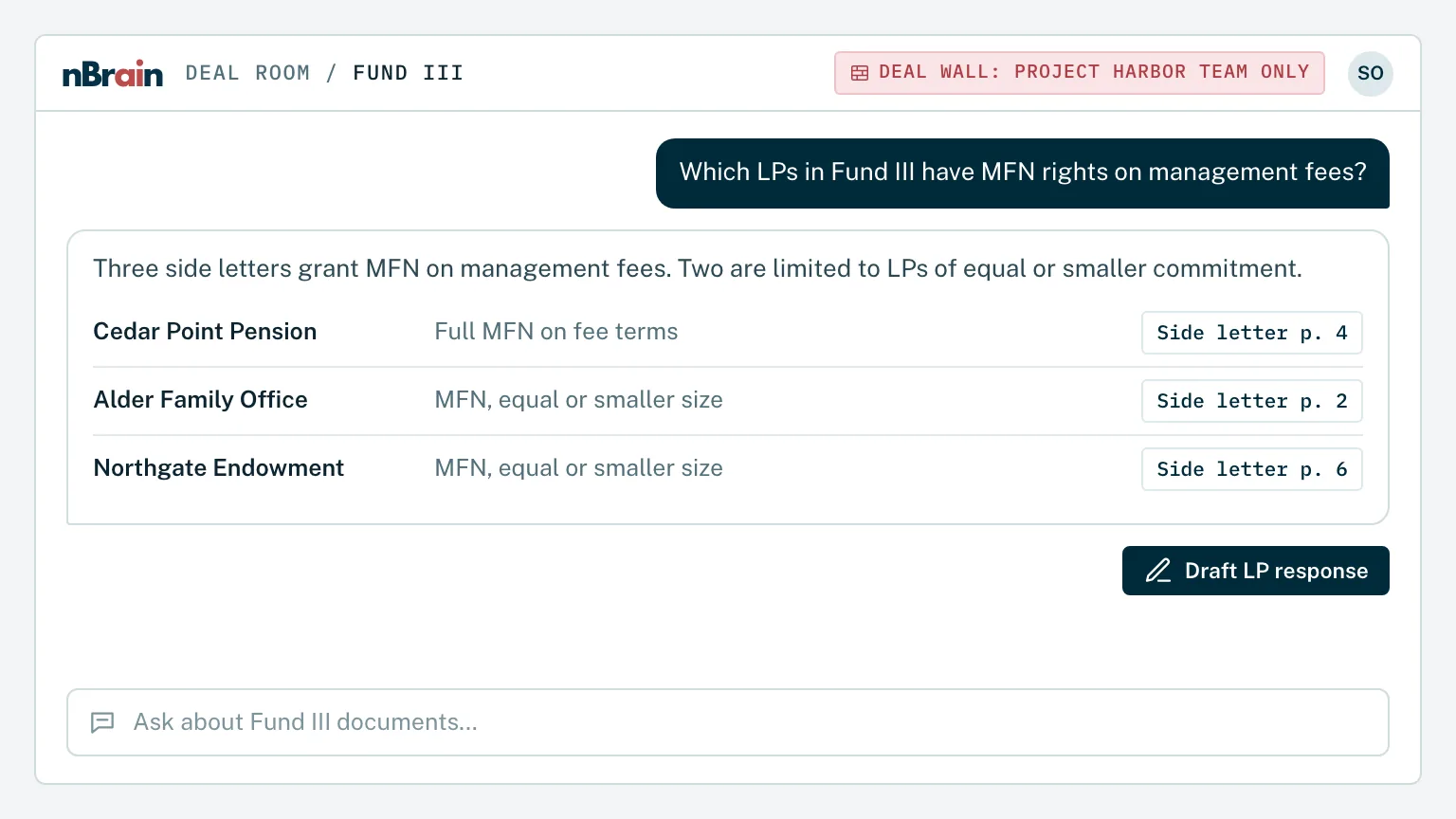
Firms that hold material nonpublic information, or confidential files for competing clients, must keep it walled off: deal team from deal team, private side from public side, one client's file from another's.
We configure walls per deal, client, fund, or entity, checked on every request, including summaries that draw on many files.
Permissions come from your identity provider and the source systems, so people only see what they can already see.
Crossing a wall requires compliance approval and is logged.
Payment controls and fraudDual control · bank-change verification
Auditors, insurers, and your own policy expect two people on every payment and independent verification of any change to bank instructions, the most common route for wire fraud.
No agent can release money. It prepares, checks, and queues. People approve and pay.
We build it so a change to a vendor's or payee's bank details opens a call-back task to a number already on file.
Invoices and wire requests are checked for duplicates, mismatches, and look-alike senders before anyone approves them.
What we do and don't claim. nBrain doesn't hold a SOC 2 report or a PCI attestation of its own. The Brain is built for regulated financial environments and deploys inside an environment you already control and audit, so it sits within your existing controls. We document the architecture, data flows, and control mapping your CCO, CISO, auditor, and LPs will ask for. Your compliance team keeps the final say on what is retained, who sees what, and what goes out the door.
Already running finance workflows. At Regal Technology Partners, invoices come out of a shared mailbox, get matched, and wait for a person to approve every one, on a private platform inside Regal's own environment. Read the story →
Deployment options
Match where it runs to how sensitive the data is.
Most firms run the Brain in their own cloud account. Firms with the most sensitive deal or client data put it on their own servers, or on a network with no internet at all. The Brain, its controls, and its audit trail are the same in all three.
Option 01 · Your cloud
Your Azure, AWS, or Google Cloud tenant
The Brain runs in a region you choose, under your accounts, your keys, and your billing. You see every resource and every model call.
Models
GPT-6 Astra, Claude Opus 5.5, or Gemini 4 Argon through private endpoints in your account, with zero retention where the provider offers it, plus open-weight models in your tenant.
Internet
Inside your private network. Outbound only to the endpoints you approve.
Updates
Released through your change-control process.
Option 02 · On-premises
Your servers, in your office or data center
Installed on hardware you own, behind your firewall. Sensitive work stays on local models, and cloud models are used only for work your policy allows.
Models
Open-weight models on your GPUs. Cloud models only behind a data-classification gate you set.
Internet
Not required for daily use. Any outbound path is yours to allow or block.
Example
A commercial real estate investor runs its Brain on a server in its own office.
Option 03 · Fully air-gapped
Disconnected, with no outbound internet
A network with no route to the internet, for deal data or client files that must never leave the building.
Models
Open-weight models such as Llama, Mistral, or Qwen, running locally on your own GPUs.
Internet
None.
Updates
Scoped per program, and approved by your team before install.
The trade-off, stated plainly
GPT-6 Astra, Claude Opus 5.5, and Gemini 4 Argon are hosted services, so a disconnected Brain uses open-weight models on your own hardware instead. Those models handle search, cited answers, summaries, extraction, and first drafts well. On the hardest multi-step analysis they can trail the frontier models, so before go-live we test them on your own documents and show you where the difference matters.
The same controls in every deployment
Barriers
Walls between deals and clients
Access set per deal, fund, client, and entity, from your identity provider. A deal team never sees another team's file.
Redaction
Account and card numbers masked
Personal and payment identifiers are masked before indexing, or kept to models running inside your environment.
Approvals
A person before money moves
Payments, client communications, filings, and record changes wait for a named approver. Two where your policy calls for two.
Audit
A record your examiner can read
Every prompt, source, model, user, and action, logged in your environment and kept on your retention schedule.
Guide · Private AI for regulated industries
Put AI to work on client and deal data, without losing control of it.
How financial firms can use frontier AI when part of their data can't leave the building: where it runs, who can see what, how records are kept, and which workflows to start with.
Built for the work finance, credit, and investment teams actually do.
Each team starts with one costly, everyday job. The Brain does the reading, matching, checking, and first drafts on your own data. Your people make the calls, and approve anything that moves money or reaches a client.
AI for accounts payable and payments
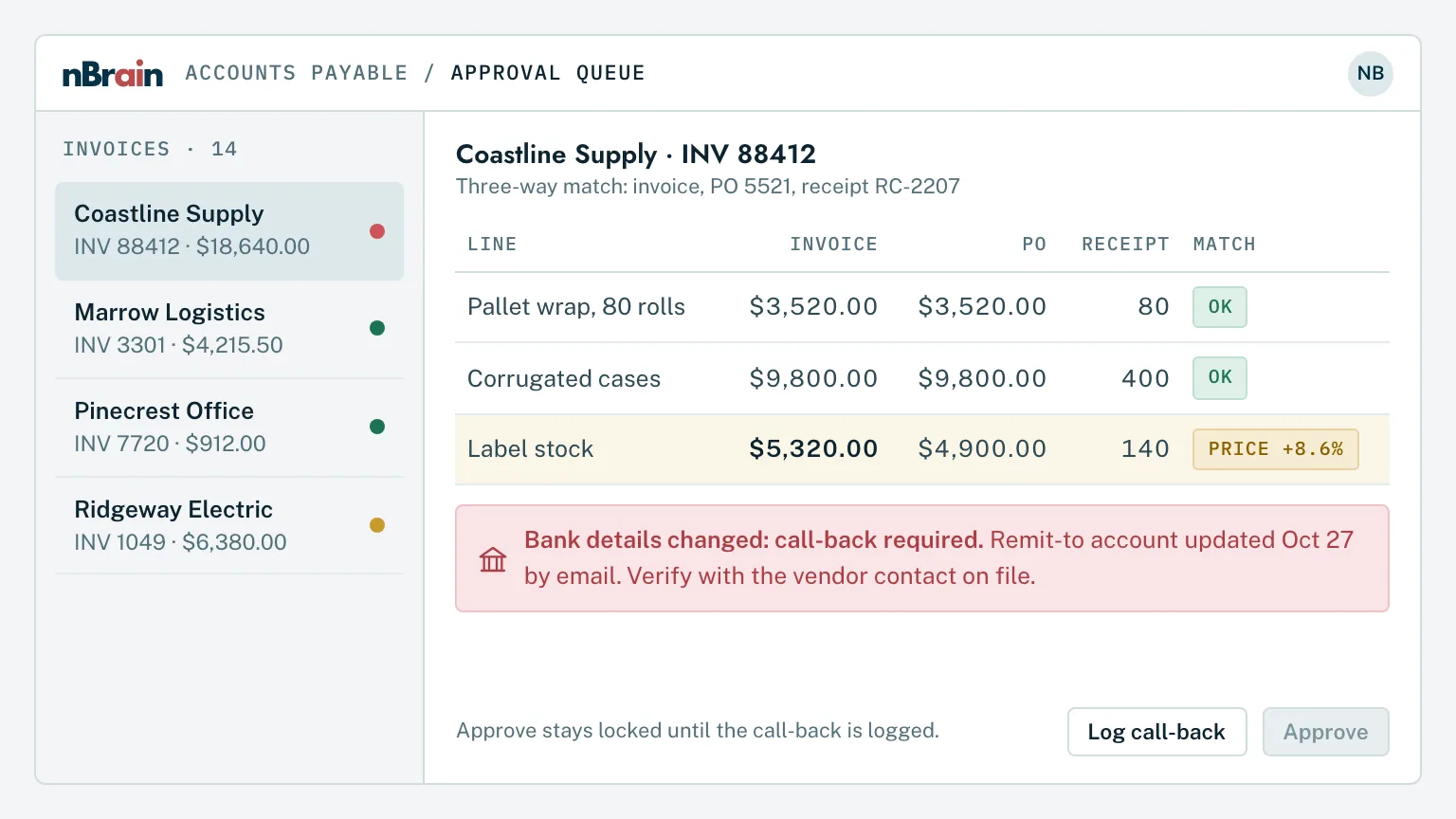
Every invoice read, matched, and checked before anyone approves it.
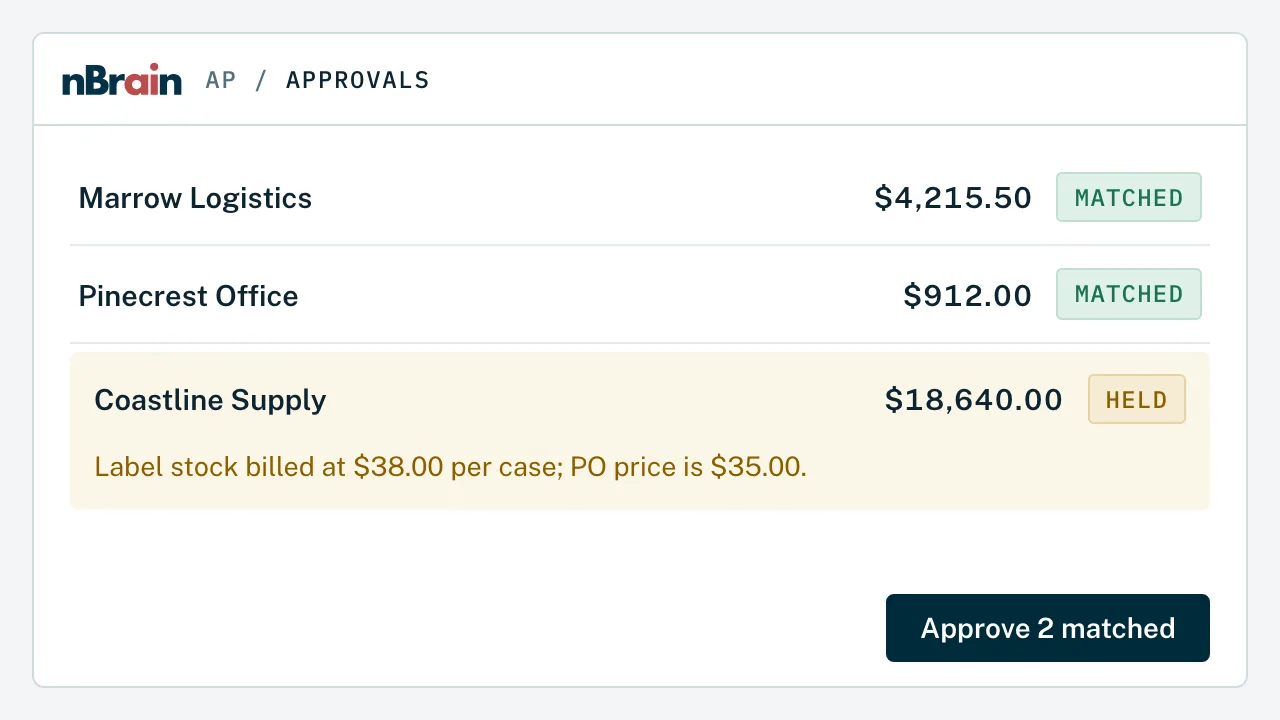
The Brain pulls bills out of the shared AP mailbox, reads every line, matches it to the purchase order and the receipt, suggests the coding, and queues it for approval. Duplicates, price and quantity mismatches, missing POs, and changed bank details are flagged before a payment is ever prepared.
Mailbox to approval queueNo more searching PDFs one at a time. Each bill arrives read, matched, and coded.
Checked against PO and receiptWithin the price and quantity tolerances your controller sets, with every exception explained.
Fraud signals before paymentDuplicate invoices, look-alike senders, and new bank instructions held for a call-back check.
Live at Regal Technology Partners since May 2026. Invoices come out of the shared mailbox, are matched to the PO and receipt, and are checked for duplicates and amount mismatches. A person approves every one.
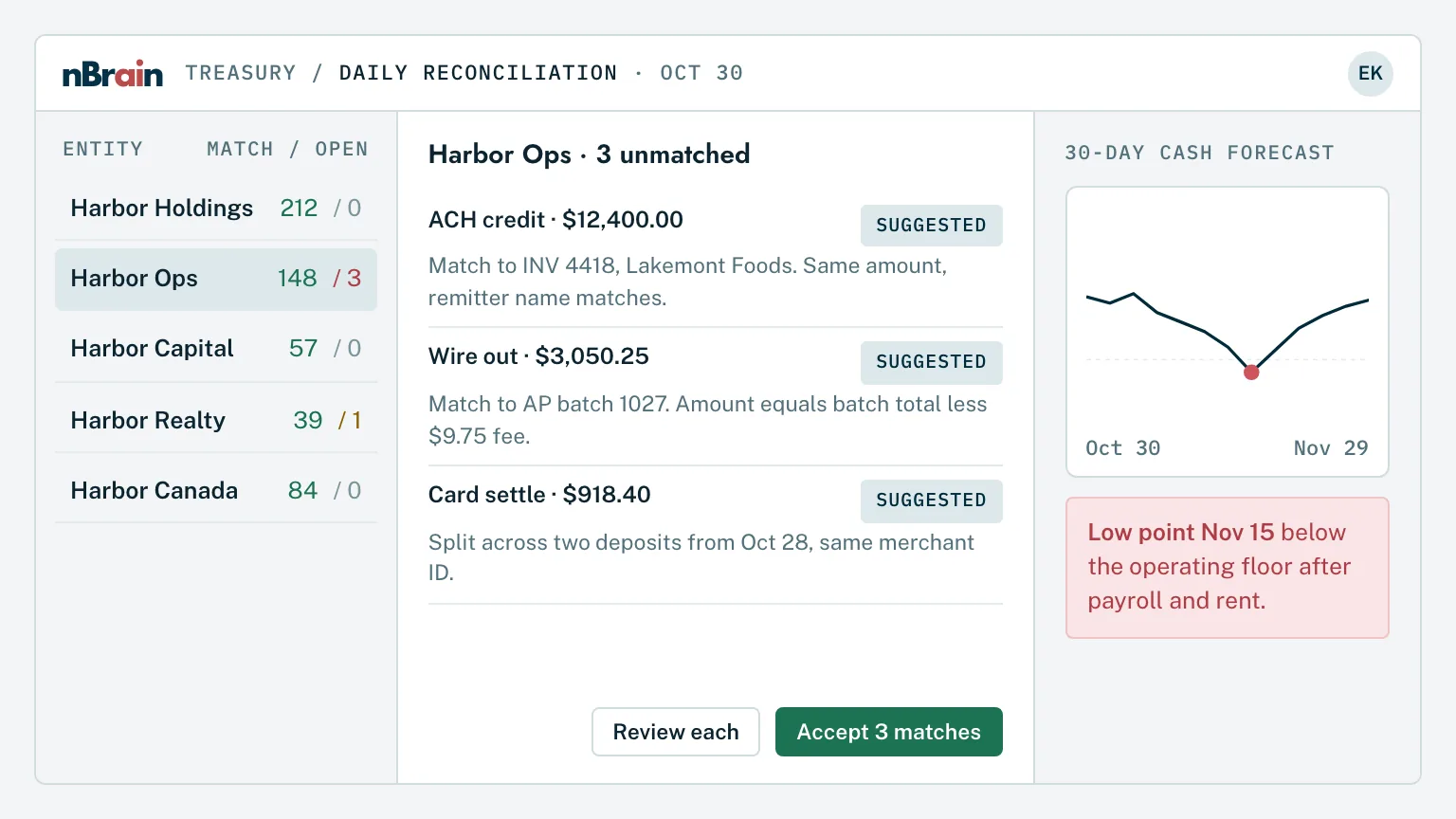
Bank against books every day, not in a scramble at month end.
The Brain reads your accounting system, bank feeds, and spend tools for every entity, matches transactions each day, and puts the unmatched items in front of your accountant with the likely cause. It drafts the variance commentary and the cash forecast, and your controller signs off.
Daily matching, every entityBank, card, and payroll activity matched to the books, read-only, with exceptions listed.
Variances explainedEach one tied to the transactions behind it, drafted for the close package.
Cash forecast on demand10, 30, and 90-day views by entity, with alerts when a balance is heading somewhere it shouldn't.
In build now. A commercial real estate developer and investor is having its Brain reconcile bank against books each day across its entities, read-only, with 10, 30, and 90-day cash forecasts.
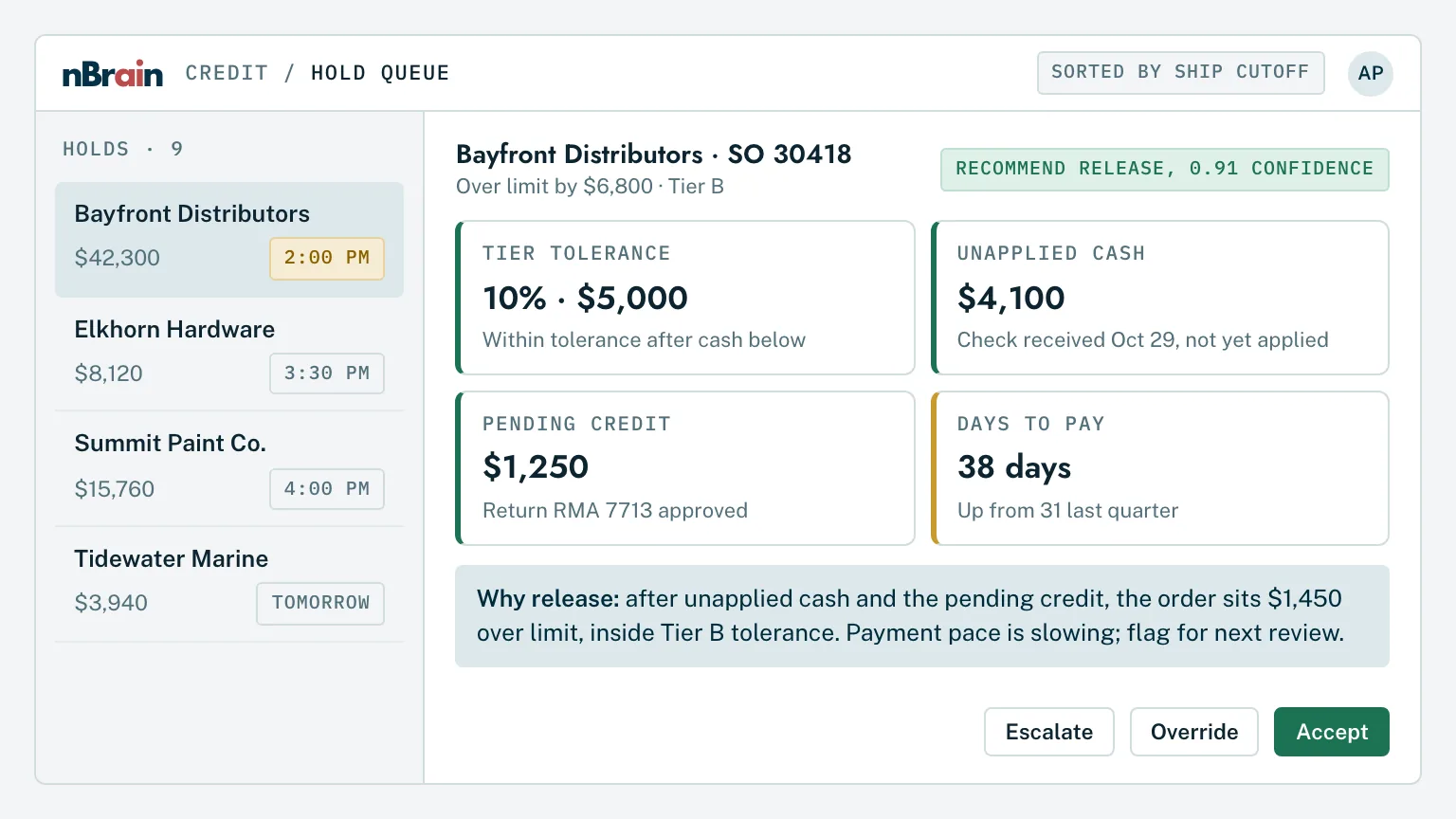
Every hold and every file reviewed the moment it lands, with the reasoning shown.
For credit teams, the Brain reviews each order on credit hold against the signals your analysts weigh by hand: tolerance by customer tier, unapplied cash, pending credits, and how the customer actually pays. For lenders, it checks each loan file against your own product rules and lists what's missing before an underwriter spends an hour on it.
A recommendation with the reasonsRelease, hold, or escalate, with every figure cited to the system it came from.
Files checked before they stallEntity documents, experience, liquidity, and income checked against your guidelines, and the next ask drafted.
Analyst overrides teach itEvery override becomes a plain-language rule your team can read and change.
The credit decision stays human. The Brain recommends first. Automatic release is only switched on for the bands credit leaders approve in writing, and disputed, high-exposure, and thin-file accounts always go to a person.
Diligence, DDQs, and LP updates, drawn from your own deal history.
The Brain reads data rooms, fund documents, side letters, and past investment memos, answers the deal team's questions with the page cited, and drafts first-pass diligence summaries, DDQ responses, and quarterly LP letters. Each deal sits behind its own wall, so only the people on it can search it.
Data-room Q&A, citedAsk about a fund's fee terms, key-person clauses, or NAV history and get the document and page.
DDQs from approved answersNew questionnaires drafted from your last approved responses, with changes highlighted for IR and compliance.
LP reporting, draftedQuarterly letters and capital account summaries started from portfolio data, finished by your team.
Your investment committee decides. The Brain gathers, compares, and drafts. Valuation, pricing, and every word that reaches an LP stay with your deal team and IR.
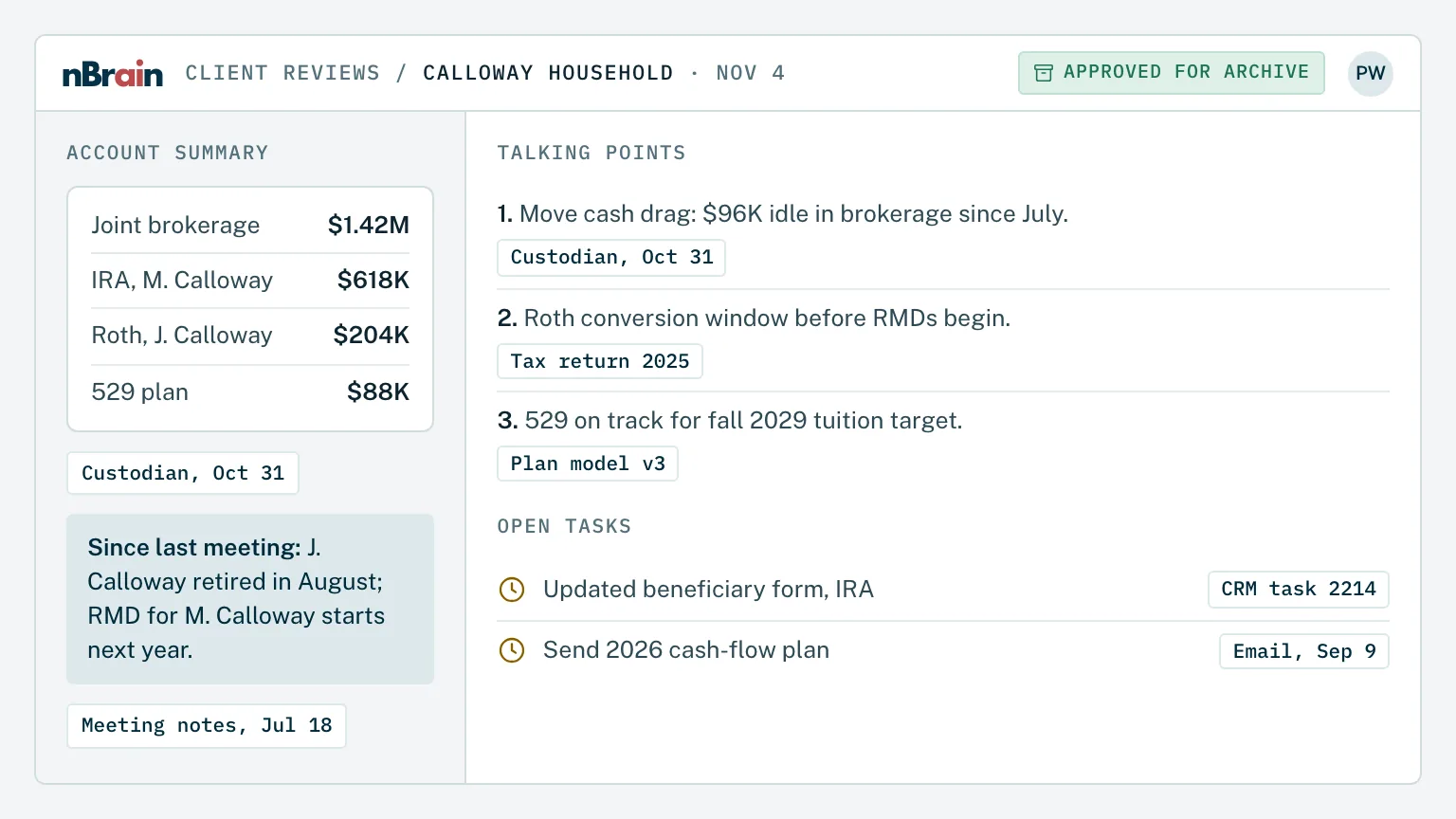
Before each meeting the Brain pulls together the client's accounts, last meeting notes, open tasks, life events, and planning documents into one brief. After the meeting it drafts the notes and follow-up for the advisor to approve, and keeps both as part of the client's record.
Meeting brief in minutesAccounts, notes, tasks, and what changed since you last spoke, in one page.
Follow-ups drafted, kept on recordNotes and emails drafted from the meeting, approved by the advisor, and archived.
Marketing reviewed before it goes outClient letters and social posts checked against your compliance rules, with flags for your CCO.
Submissions and claim files read in full, not skimmed.
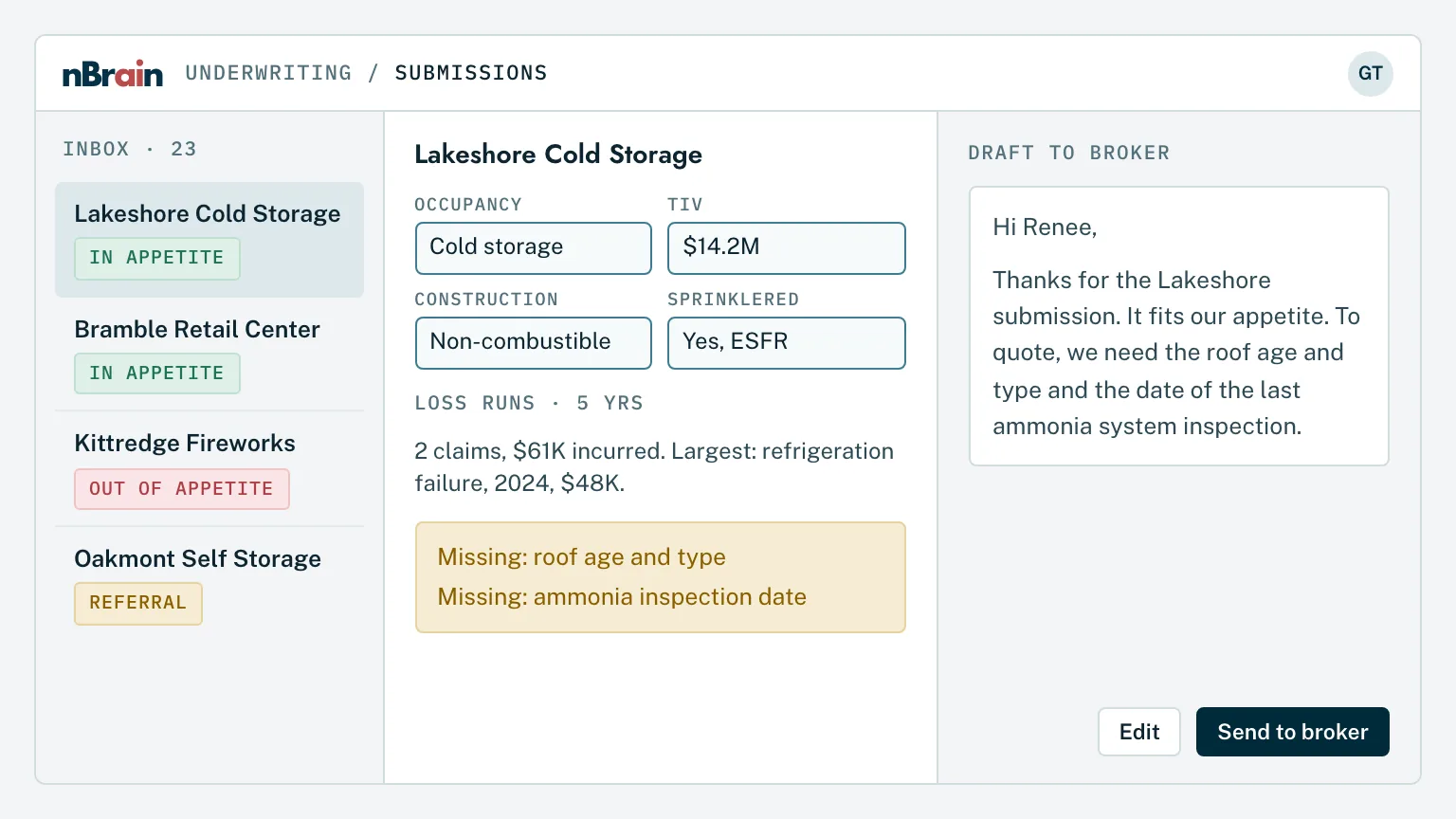
The Brain reads broker submissions, loss runs, applications, and inspection reports, checks them against your appetite and guidelines, and hands the underwriter a summary with what's missing. On claims, it builds the file summary from notes, photos, and documents, and flags coverage questions for the adjuster.
Submission triageIn appetite, out of appetite, or missing information, with the reasons.
Claim file summariesEvery note, document, and photo condensed, with the source for each point.
Guidelines that answer backUnderwriters ask the manual a question and get the section, not a search result.
Binding and payment stay human. The Brain prepares and flags. Underwriters bind, adjusters decide, and every claim payment is approved by a person.
Every file tracked to close, and every wire instruction verified.
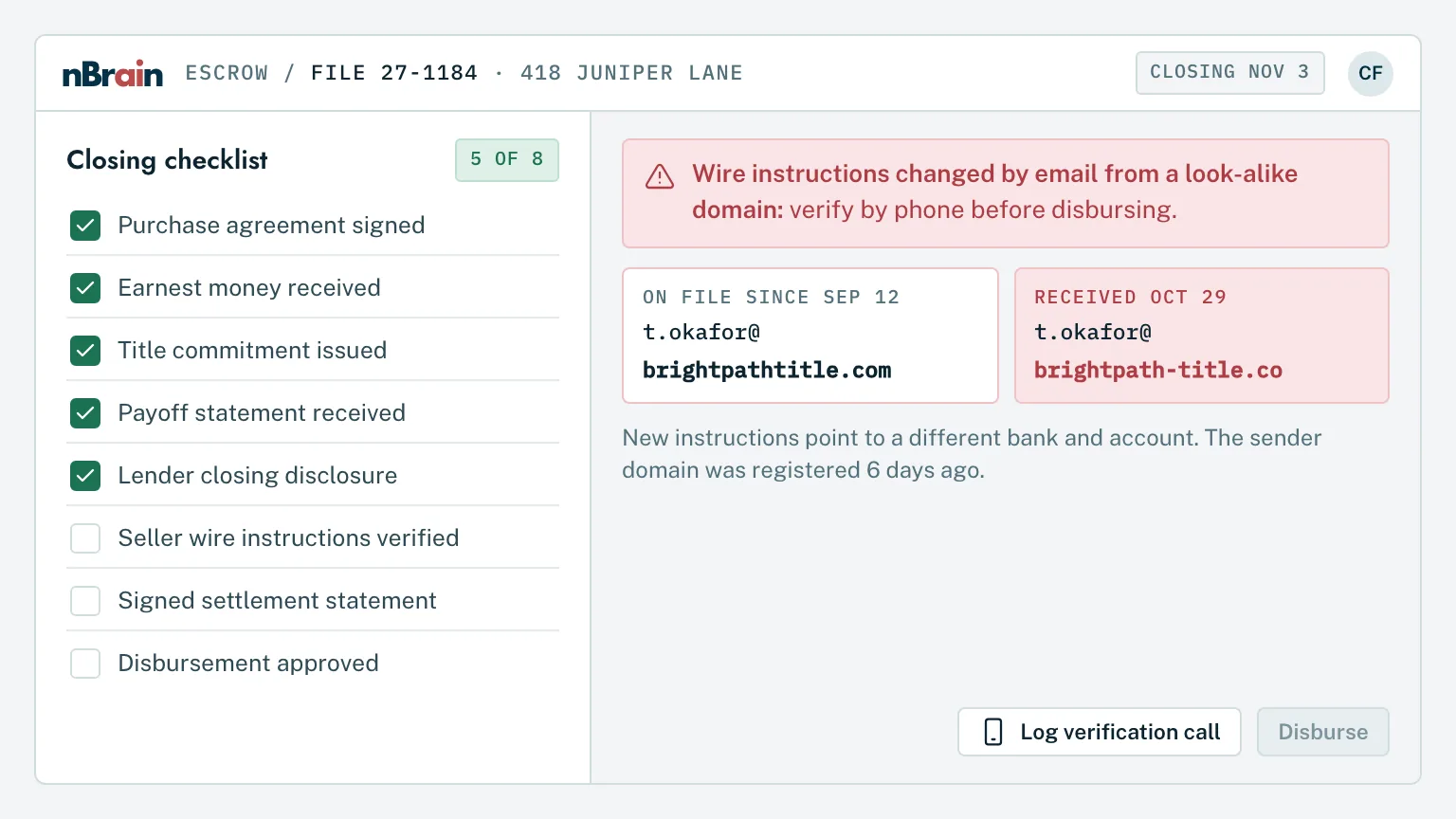
The Brain reads new orders from agents and lenders, opens the file, builds the closing checklist, and chases missing documents. It reads every email that mentions wiring funds, flags changed instructions and look-alike senders, and holds disbursement until a person has verified by phone.
Order intake to open fileParties, property, lender, and dates captured from the order, ready for the escrow officer.
Checklist that chases itselfMissing payoffs, signatures, and demands listed, with reminders drafted for approval.
Wire instructions verifiedChanged instructions and spoofed senders flagged before any funds go out.
Policy questions answered with the citation, audits prepared from the record.
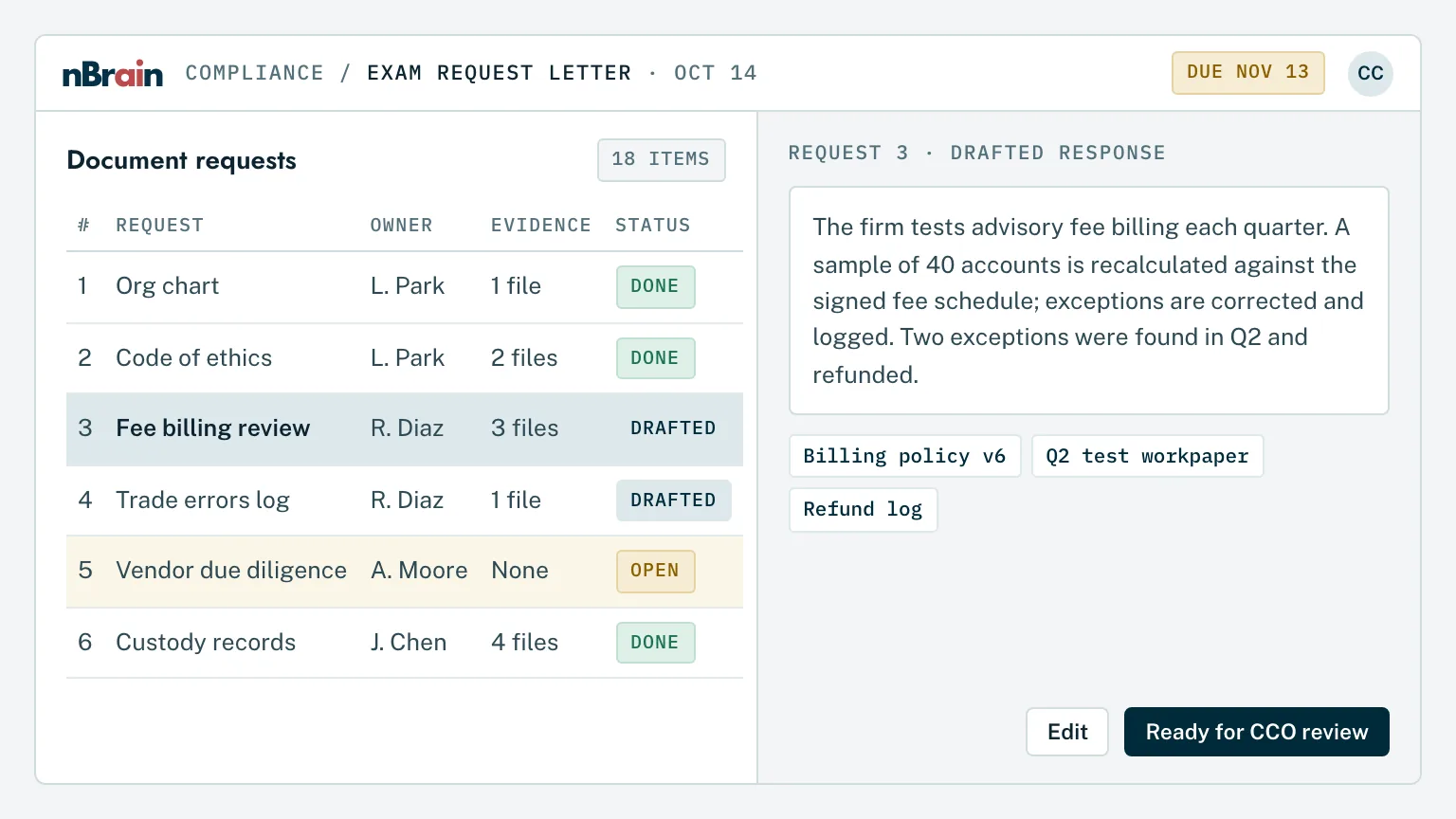
Staff ask the Brain about your policies, procedures, and regulatory guidance and get the answer with the exact section. For audits and exams, it gathers the evidence, maps it to each request, and drafts the response for your compliance team to review.
Cited policy answersEvery answer shows its source, and the Brain says so when it can't find support.
Exam and audit requests organizedEach request mapped to the records that answer it, with gaps listed early.
What changed, and what it affectsNew rules compared against current procedures, with the affected sections listed for review.
Your CCO signs off. The Brain organizes evidence and drafts. Your compliance team approves what goes to an examiner, auditor, or LP.
One Brain, built inside your environment, one workflow at a time.
Your systems feed one knowledge layer. The Brain routes each task to the right model and takes action in the tools your staff already use, under the rules you set.
Step 01
Deploy
Stood up in your own cloud account, on your own servers, or on a network with no internet.
Your identity provider, roles, and walls
Encryption in transit and at rest
The region you choose
Step 02
Connect
Your accounting, banking, CRM, and document systems, read-only by default.
NetSuite, QuickBooks, Microsoft Dynamics
Salesforce, HubSpot, Microsoft 365
Loan, policy, and custom systems by API or export
Step 03
Act, with approval
Agents read, match, check, and draft. A person approves anything that moves money or reaches a client.
Approval queues by role and amount
Citations on every answer
Low-confidence answers flagged
Step 04
Measure and expand
We take a baseline in month one, then add the next workflow on the same data and permissions.
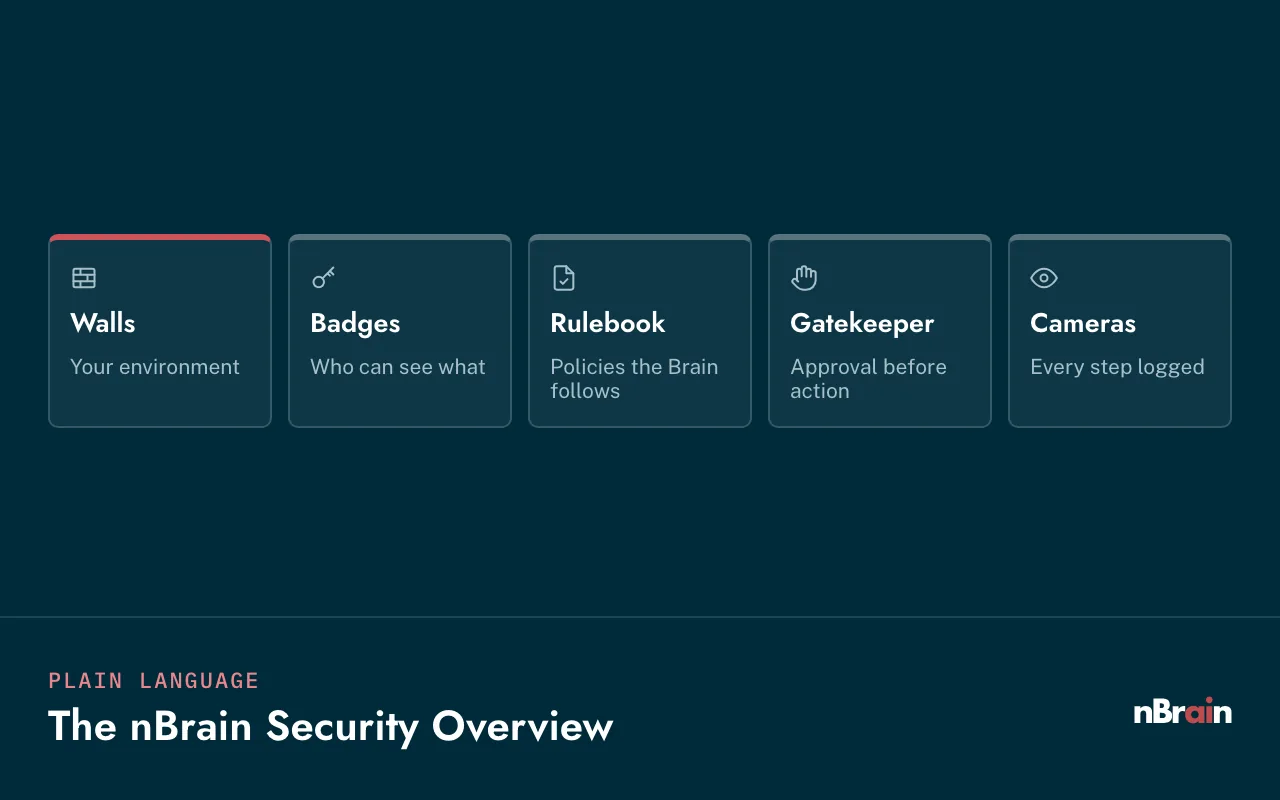
The first question a CFO or CCO asks isn't "what can it do?" It's "where does client data go, who can see it, and what happens when it's wrong?" These controls are built in from the first week.
Runs in your environment
In your cloud account, on-prem, or air-gapped, so client and deal data stay where you already protect them. Your data never trains public models.
Information barriers, enforced
Walls between deals, funds, clients, and entities, mirrored from your identity provider and checked on every request.
Approvals before money moves
Payments, wires, client communications, and record changes wait in a queue until the right person, or two, approves.
A full audit trail
Which data, which model, which person, and which action, recorded every time, ready for your examiner, auditor, or LP.
Records rules respected
Prompts, outputs, and logs follow your retention schedules and legal holds, and can be produced on request.
Built for SEC and FINRA recordkeepingDesigned to support GLBA safeguardsFits inside your SOC 2 scopeKeeps card data out of scopeRegion of your choiceOn-premises or air-gappedData never trains public models
What we do and don't claim. nBrain doesn't hold a certification or attestation that covers your data. The Brain deploys inside an environment you already control and audit, so it sits within your existing controls like any other system you run. Your data stays in your environment, and our staff reach it only through accounts you issue and can revoke.
Each agent has one job, a defined set of tools, and guardrails on what it can do. They share the same data, walls, and audit trail, so each new one ships faster than the last.
Accounts payable
Invoice matcher
Reads each bill, matches it to the PO and receipt, and suggests the coding.
Payments
Payment and bank-change verifier
Flags duplicates, look-alike senders, and new bank details, and holds them for a call-back.
Accounting
Bank reconciliation
Matches bank, card, and payroll activity to the books every day, by entity.
FP&A
Close and variance explainer
Drafts variance commentary and cash forecasts from the ledger.
Credit
Credit hold recommender
Scores each hold on your signals and recommends, with the reasons shown.
Deal teams
Diligence and DDQ drafter
Cited answers from data rooms, and DDQs drafted from approved responses.
Investor relations
LP and client report builder
Drafts quarterly letters and client reviews from portfolio and account data.
Compliance
Policy and communications reviewer
Checks outgoing letters and posts against your rules, and answers policy questions.
These come from Brains nBrain has built or is building for clients today. Each one maps to work finance, credit, and investment teams do every day.
Regal Technology Partners · Accounts payable
Invoices go from a shared mailbox to approved, with a person on every one.
A Tier 2 defense manufacturer's AP clerk used to work the invoice mailbox by hand. Now each bill is pulled out, matched to its PO and receipt, checked for duplicates and amount mismatches, and queued for approval.
May 2026
live in production, inside Regal's own environment
Commercial real estate developer and investor
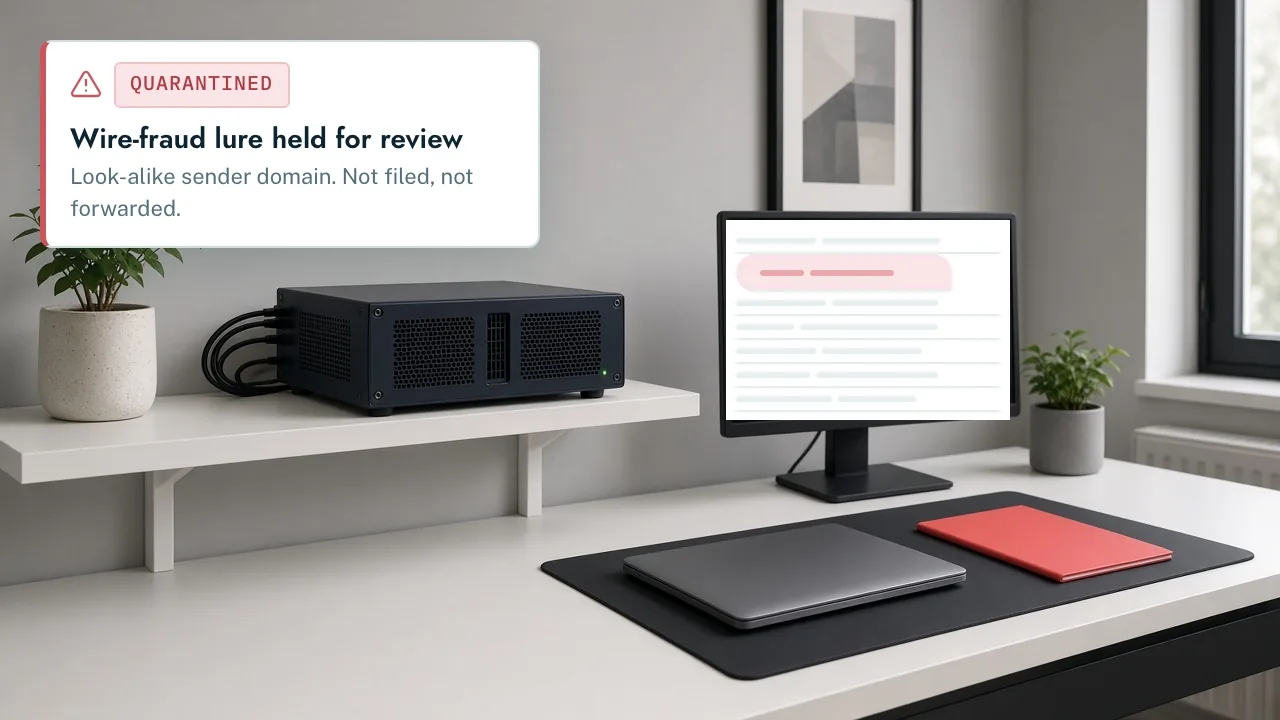
A Brain on its own server, with wire-fraud lures caught before anyone acts.
The Brain runs on a server in the firm's own office, so sensitive deal and banking mail never leaves the building. It sorts 19 years of email, and quarantines phishing and wire-fraud lures for review instead of filing them. Daily bank-against-books reconciliation is in build.
~98%
of everyday mail sorted correctly in evaluation, on local models
~2%
sent to a person when the Brain isn't sure
Multi-company operating group · Billing
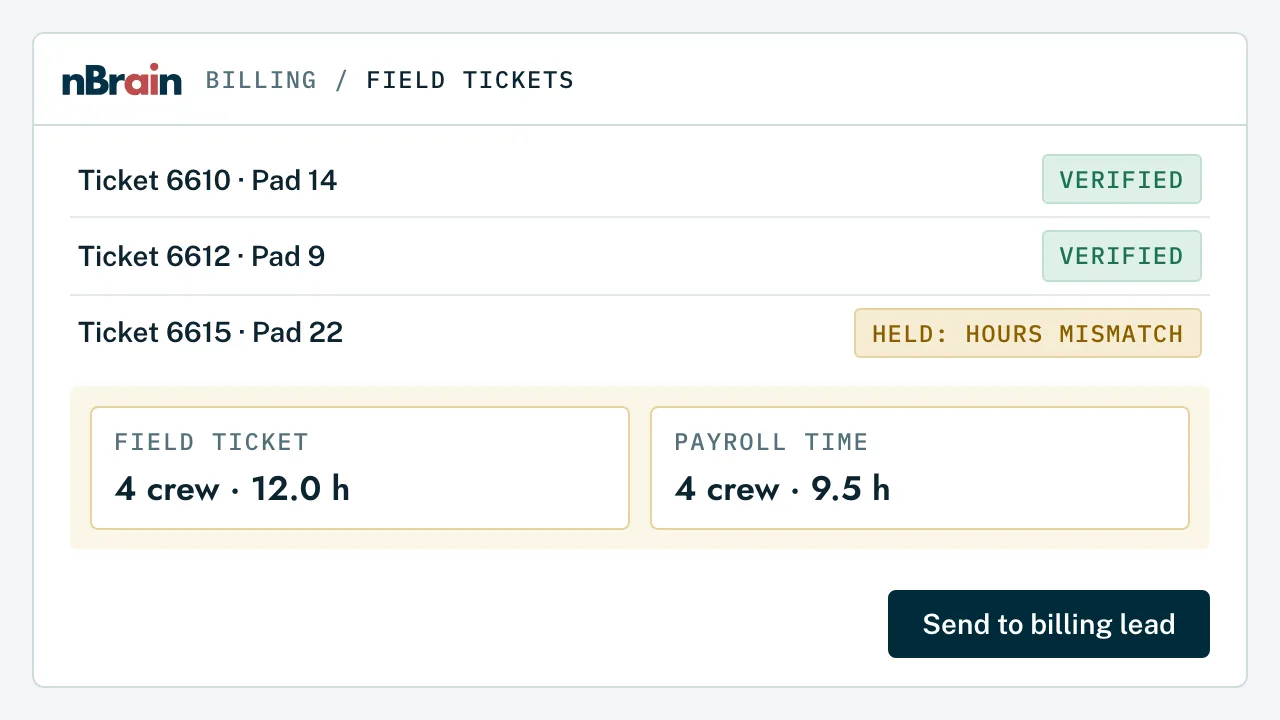
Every billable ticket checked against payroll and GPS time before it's invoiced.
The billing team's Brain checks each field ticket against payroll time, GPS time, and the required safety paperwork, sends mismatches to an exception queue, and assembles one invoice package per job. Each company's staff see only their own company's data.
9
finance and operations systems connected, including accounting, payroll, and spend
1
login for every company in the group, each behind its own wall
Results are anonymized except where the client has agreed to be named. Figures are from client work and are labeled where they come from evaluation or are still in build.
Straight answers
The questions CFOs, CCOs, and managing partners ask us first.
Does our client data go to OpenAI, Anthropic, or Google?
Not to their public services, and never to train their models. Where you allow frontier models, the Brain calls private endpoints in your own cloud account, such as Azure OpenAI or AWS Bedrock, with zero retention where the provider offers it. For anything you don't want leaving your hardware, it uses open-weight models running in your environment. You decide which models may see which data, and every call is logged.
Will it meet SEC and FINRA recordkeeping rules?
It is built to support them. Every prompt, source, output, and approval is logged in your environment, your retention schedules and legal holds apply, and anything that becomes a client communication can be sent to the archive you already use for email and chat. Nothing reaches a client without a person approving it. Your compliance team decides what counts as a record and how long it is kept.
Does nBrain have a SOC 2 report?
nBrain doesn't hold a SOC 2 report of its own today. For most firms that isn't the question that matters, because nBrain doesn't host your Brain. It runs inside your environment, so it falls within the controls your SOC 2 auditor already tests. We provide the architecture, data-flow diagrams, and control descriptions your auditor and your LPs' DDQs will ask for.
How does it support our GLBA safeguards program?
The Brain runs on infrastructure you already protect, so it inherits your encryption, MFA, access controls, and monitoring. Access follows your identity provider, nonpublic personal information can be masked or kept to models inside your environment, and logs stream to your SIEM for incident response. We document it for your written security program and your vendor-oversight file.
Can it keep information barriers between deals and clients?
Yes. We configure walls per deal, fund, client, or entity, and every request is checked against them, including summaries that draw on many documents. Permissions come from your identity provider and source systems, so people only see what they can already see. Crossing a wall requires compliance approval, and it is logged.
Can the AI move money?
No. Agents read, match, check, and prepare. They can't release a payment or a wire. Every payment waits for the approvers your policy requires, two where it calls for two, and every approval is recorded.
How does it help with payment and wire fraud?
It checks every invoice and payment request before a person approves it: duplicates, amounts that don't match the PO, look-alike sender addresses, and new or changed bank instructions. We build it so a bank-detail change opens a call-back task to a number already on file. Suspicious messages are quarantined for review instead of being filed. It reduces risk. It doesn't replace your verification procedures.
What about card data and PCI?
The Brain is designed to stay out of your cardholder data environment. Card numbers can be detected and masked before anything is indexed or sent to a model, and payment systems connect read-only to tokenized fields. If a workflow genuinely needs card data, we scope it with your PCI assessor first.
Can our data stay in one region?
Yes. You choose the region, and the Brain, its indexes, logs, backups, and model endpoints stay in it. For the most sensitive data it can run on your own servers, or on a network with no internet connection.
What happens when the AI gets something wrong?
It will sometimes be wrong, so it's built for that. Answers show their sources, low-confidence answers are flagged and sent to a person, and anything that moves money or reaches a client waits for approval. Every step is logged, so you can see what happened and why, and corrections become rules the Brain follows next time.
What does it cost?
Builds start at $40,000, and a typical build takes about three months. Running costs, meaning your own cloud and model accounts, are billed to you directly at list price, with no markup. Because each task is routed to the right model, model usage typically costs about 65% less than sending everything to one top-tier model.
Where should a financial firm start?
With one high-volume workflow where people spend their day reading, matching, and re-keying: AP invoice matching, bank reconciliation, credit holds, loan file checks, DDQs, or client review prep. We take a baseline in month one and measure hours returned, then add the next workflow on the same foundation.
Should we build this in-house instead?
Your team can build a chatbot. Most of the work is in what sits around it: permission-aware search, information barriers, model routing, evaluation, approval gates, audit logs, and keeping all of it current as models change. We bring that layer already built. Your IT team stays involved, owns the code and data, and can take it over at any time.
Put private AI to work on your ledgers, files, and deals.
In one strategy session we map where a Brain would give your team the most time back, which deployment fits your data, and what your CCO, CISO, auditor, and LPs will want to see.